


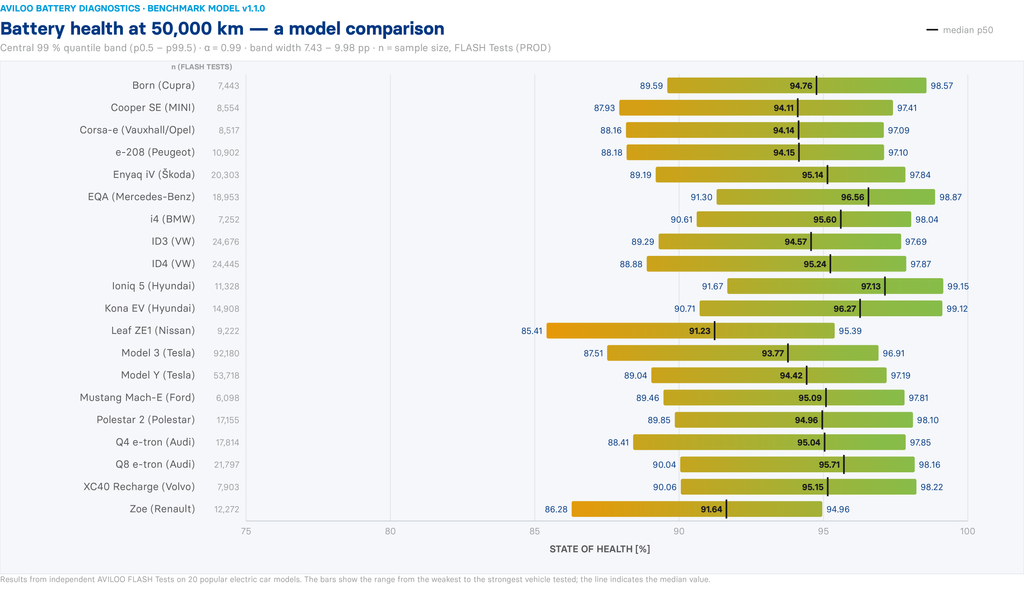
- A study of 500,000 EV battery health tests reveals which popular cars age most gracefully.
- The Tesla Model Y and Model 3 held up well, but they weren’t top of the pack.
- The research shows that after close to 100,000 miles, popular EVs tend to still have at least 90% of their battery capacity and range.
Worried that an EV you buy today will end up like that old laptop or smartphone you have sitting in a drawer in a few years? Don’t be. A new study of 500,000 EV battery health tests over the last five years confirms that, by and large, electric car batteries hold up remarkably well over tens of thousands of miles. Just remember: The car you choose and what you do with it can change the picture dramatically.
The new data comes courtesy of Aviloo, an EV battery diagnostics company. It compiled the results from half-a-million health tests spanning 20 popular electric car models. The battery checks of used EVs occurred from 2022 to 2026 across North America, South America, Europe, Asia, and Australia.
Aviloo’s state-of-health scores reflect the percentage of a battery’s original usable capacity that’s still available. In other words, an EV with an observed 95% state of health should return about 95% of its original range on a full charge. For each model, Aviloo calculated the median state of health at three milestones: 50,000 kilometers (31,068 miles), 100,000 km (62,137 miles), and 150,000 km (93,205 miles).
There were clear winners and losers. So let’s dive in.
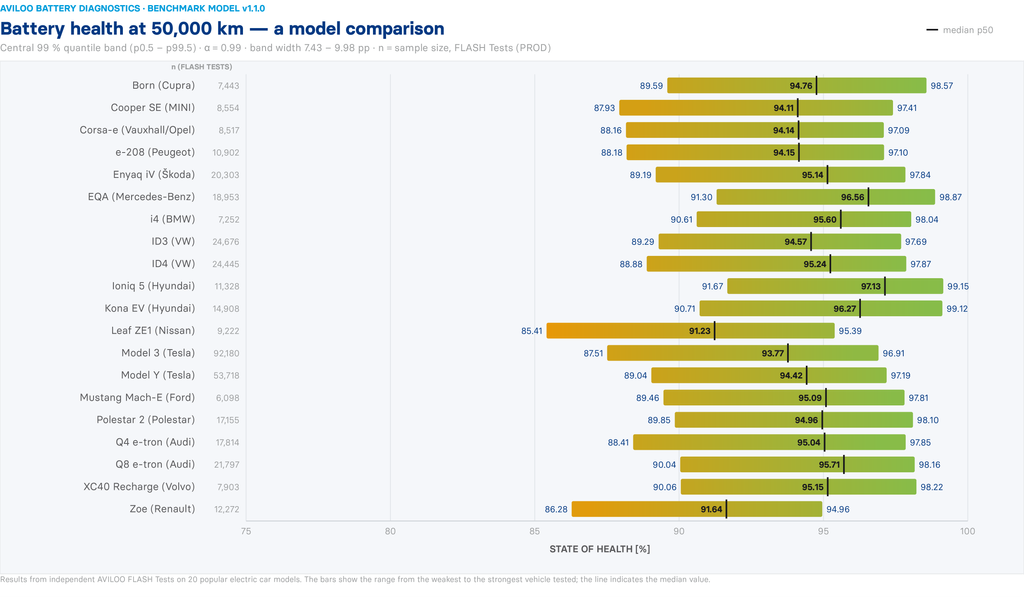
After 50,000 km, the Hyundai Ioniq 5 fared best.
Photo by: Aviloo
After 50,000 km, the Hyundai Ioniq 5 had the most capacity remaining in the study. It was still basically a new car from a range perspective, with a median battery capacity of over 97%. The Mercedes-Benz EQA, a compact crossover we don’t get in the States, came in second place with 96.56%. All 20 models earned median scores over 90%.
What’s even more reassuring is that excluding two outliers—the Renault Zoe and Nissan Leaf, which are some of the few EVs to use air-cooled batteries—all notched a median health of roughly 94% health or higher. Aviloo notes that vehicles with smaller batteries (such as the pint-sized Zoe and Leaf) tend to see faster degradation, since they need more top-ups to go the same distance. And those extra charging cycles add up over time.
At 100,000 km, the Ioniq 5 was the winner again, with over 95% capacity remaining. Other top performers included EQA (95%), Hyundai Kona Electric (94.3%), BMW i4 (94.3%), and Ford Mustang Mach-E (93.45%). Excluding the outliers again, all models notched at least a 90% median health score.
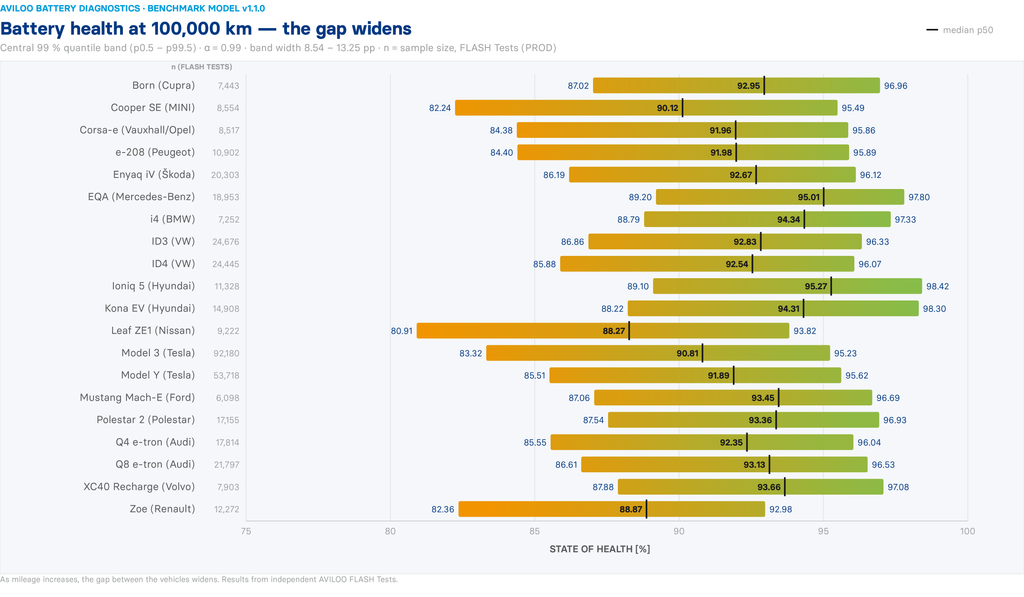
After 100,000 kilometers, EVs tended to degrade more but the Ioniq 5 still led.
Photo by: Aviloo
At 150,000 km, the median values tended to cluster between 90% and 94% for most models. That’s apart from smaller EVs like the Mini Cooper SE (87.11%), Leaf (86.67%), and Zoe (87.33%). The Ioniq 5 and EQA virtually tied for the top spot, at 93.79% and 93.97% capacity, respectively. The i4 (93.62%), Kona EV (92.95%), and Volvo XC40 Recharge (92.79%) weren’t far behind.
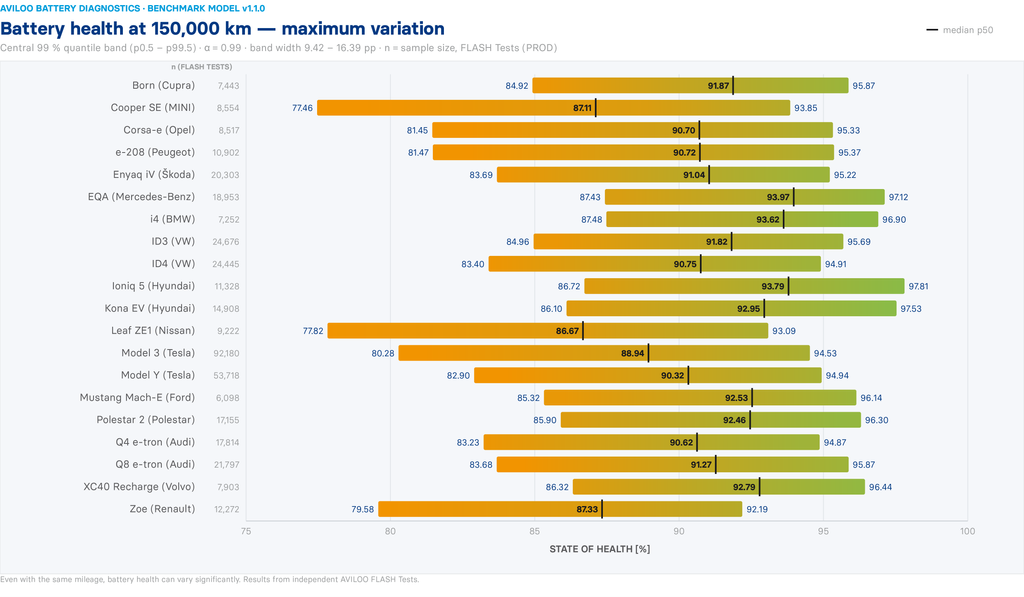
After 150,000 kilometers most EVs in the study still had over 90% of their battery capacity and range.
Photo by: Aviloo
The two Teslas in the study—the Model Y and Model 3—landed in the middle-to-bottom end of the pack. After 150,000 km, Model Ys showed a median health of 90.3%, while Model 3s came in at 88.94%. The clear standout was the Ioniq 5, which won two categories and proved itself to be a longevity champ in this particular study.
The report reiterates what we’ve learned from other research: Popular EVs tend to retain most of their range—sometimes well over 90%—even after close to 100,000 miles. Even the worst performers in this dataset still had around 87% of their battery capacity remaining after several years of use.
Things get a little more complicated when you consider the range of outcomes though, which can be vast between cars and even within a particular model. In its study, Aviloo highlighted the range of outcomes that encompass 99% of examples for a given model/mileage. Results can vary dramatically—both above and below the median.
For the Model Y after 150,000 miles, it’s anywhere from 82.9% to 94.9%. For the i4 it’s 87.5% to 96.9%. For the Mustang Mach-E it’s 85.3% to 96.1%. For the Model 3, it’s 80.28% to 94.53%. On the one hand, it’s astonishing that some vehicles with that many miles still have nearly 100% of their original usable battery capacity. But it could also be a lot less than that.
Aviloo told me that hotter climates, frequent fast charging, and keeping a car topped up to 100% for hours on end can all explain the spread in outcomes. Technical differences between models come into play too. “Manufacturers also use different battery chemistries with different trade-offs, so even identical charging habits can produce very different results across models,” an Aviloo representative said via email. Research also shows that calendar age plays a role.
For EV owners and shoppers, the takeaway is mostly good news: Batteries aren’t turning into bricks after 100,000 miles. It seems like after about that much mileage, you can reasonably expect a 10% drop in range. Just don’t take that as a guarantee either; what you drive and how you treat it can make a big difference over the long haul.
Contact the author: Tim.Levin@InsideEVs.com
