


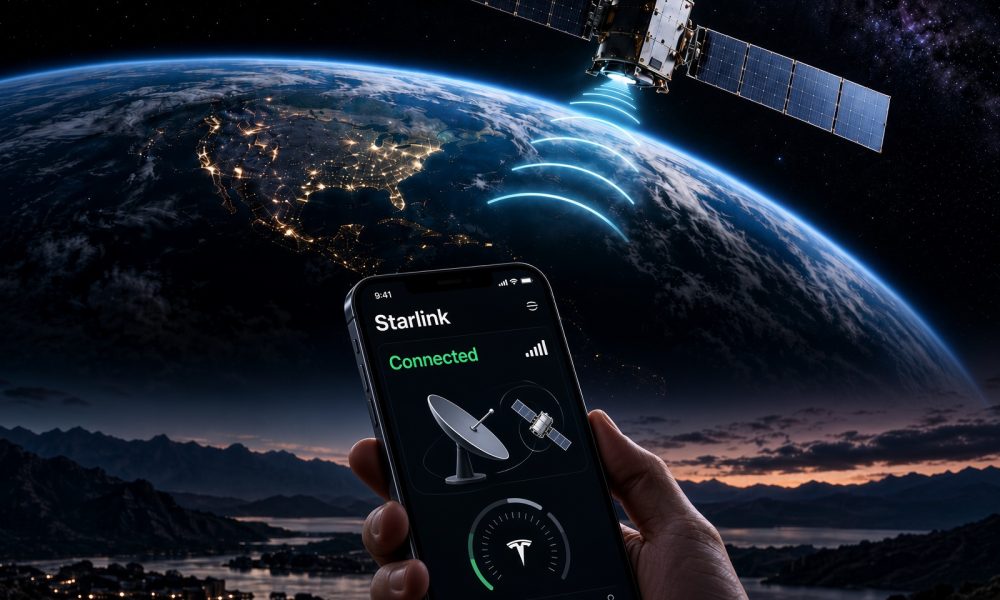
AT&T, Verizon and T-Mobile are asking the Federal Communications Commission to pull nearly 300 MHz of spectrum out of a proposal that would let satellite companies like SpaceX offer cell service directly to ordinary phones. The request lands one day before the agency votes on it.
The FCC will vote Thursday, October 29, on a notice of proposed rulemaking that would make an additional 482 MHz available for direct to device service, expanding the number of eligible bands from five to 13, according to the FCC fact sheet. It would also scrap the rule requiring a satellite operator to lease spectrum from carriers, replacing it with a certification that the operator has coexistence agreements in place or holds the terrestrial license itself.
That second path matters for SpaceX. As Teslarati reported earlier this month, SpaceX agreed to buy Grain Management’s nationwide 800 MHz portfolio to turn Starlink Mobile into a full US carrier, adding to the spectrum it already bought from EchoStar.
The carriers want two bands removed, 2.5 GHz and 3.45 GHz, which make up 290 MHz of the 482 MHz on the table. Through industry group CTIA, they argued that about 300 million users depend on those bands and that satellite operations in them are not technically feasible. T-Mobile, which calls 2.5 GHz the foundation of its Ultra Capacity 5G network, said in its own filing that satellite interference could wipe out up to 96% of a cell site’s uplink coverage area and cut uplink speeds by 88% to 99%.
Executives from all three carriers met with FCC staff on October 20, and T-Mobile CEO Srini Gopalan met separately with FCC Chairman Brendan Carr. T-Mobile’s role stands out because it is still SpaceX’s US launch partner for Starlink Mobile. The three carriers have also teamed up on their own satellite joint venture to pool spectrum, a move widely seen as a response to Starlink.
SpaceX is asking for the opposite. In an October 23 filing after meetings with FCC staff and commissioners’ offices, the company asked regulators to add the 902 to 928 MHz band to the proposal. “Doing so now saves time later,” SpaceX wrote. The company also asked the FCC to modernize interference rules and align satellite deployment requirements with those for terrestrial cell networks, saying the goal is to let satellite and ground networks work together so Americans stay connected wherever they are.
The carriers have not been shy about how they view SpaceX as a competitor. On Verizon’s third quarter earnings call Monday, its chief executive said Starlink Mobile “just can’t compete with a terrestrial network” and estimated SpaceX would need four to six years and $300 billion to $500 billion to build a full US carrier network.
Thursday’s vote will not settle which bands survive. Adopting the notice opens a public comment period, with final rules to come later in the proceeding. The FCC already considered and rejected 2.5 GHz for satellite coverage once, in 2024. SpaceX also is not the only satellite player watching: the FCC approved Amazon’s $11.6 billion acquisition of Globalstar on October 27, giving its planned direct to device fleet its own mobile satellite spectrum.
