


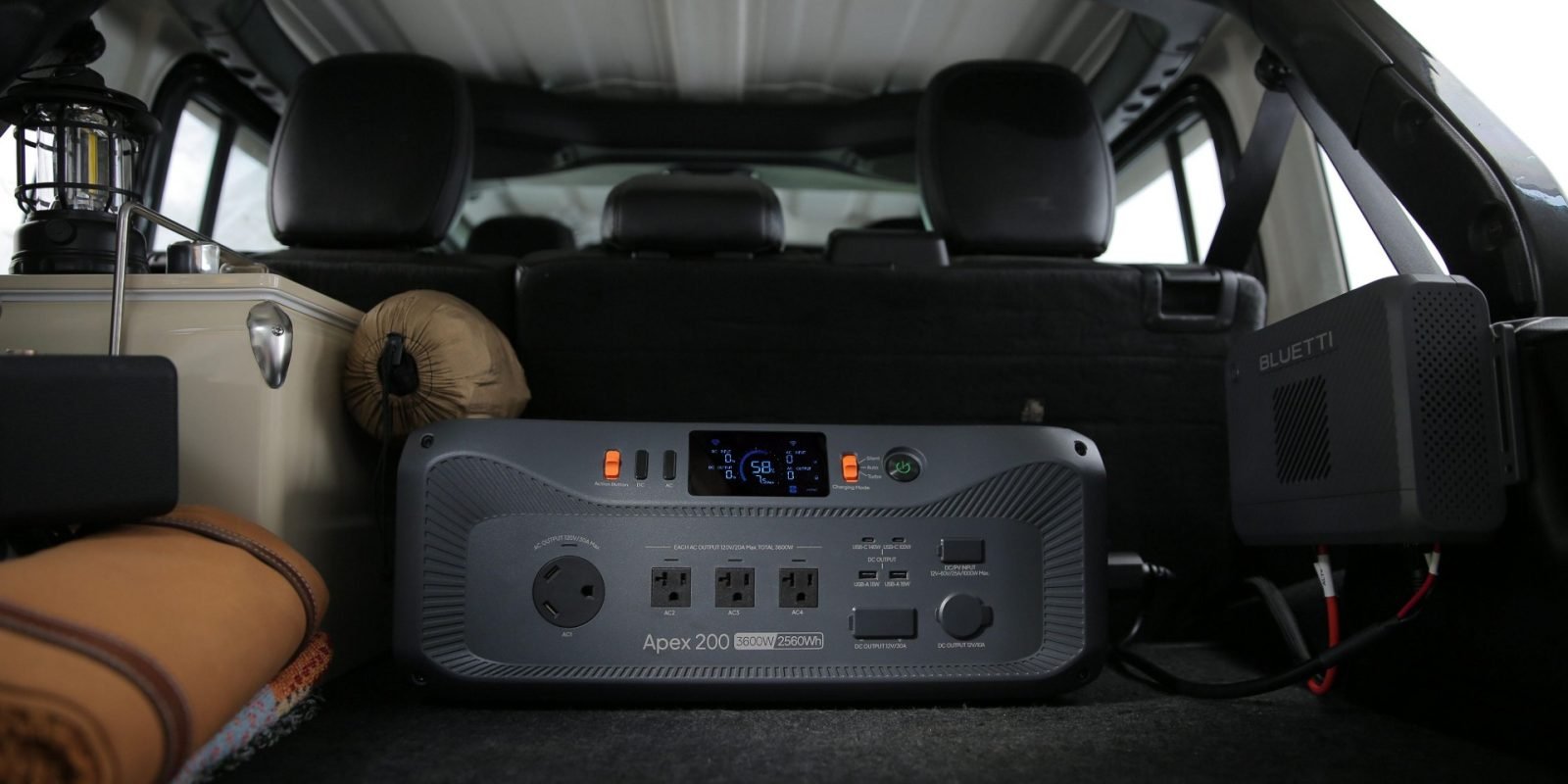

What do you actually need to keep running when the power goes out? For most households, the fridge, wifi, phones, and a few other essentials come first. Buying enough battery storage for every appliance in the house can come later – and that’s the appeal of BLUETTI’s latest launch, the Apex 200 portable power station.
The Apex 200 starts with 2.56kWh of storage and 3.2kW of continuous AC output, with the option to add batteries when you need longer backup. Built-in RV connections also mean it can earn its keep between blackouts.
BLUETTI launches the Apex 200 on November 4, with standalone super early-bird pricing starting at $1,099 through November 18. Electrek readers can get an extra 5% off with code ELECTREK5OFF.
Here’s how to work out which setup is worth buying for your home or RV.
Start with the battery you need now

The Apex 200 takes the expandable design of BLUETTI’s flagship Apex series and puts it in a smaller package.
You get a 2,560Wh lithium iron phosphate (LFP) battery. The 3.2kW of continuous AC output increases to 3.6kW when an expansion battery is connected or the unit is actively charging.
The enclosure holds all that in 36.2 liters and weighs 26.9kg (59.3 lb). You’ll want two hands to move it, but it’s convenient to move it between home and your camper.
BLUETTI’s UltraCell technology delivers an industry-leading energy density of 70.7 Wh/L, yet the Apex 200 is more than 50% smaller by volume than class competitors. For an RV owner, that smaller footprint frees up room for other gear.
There’s also a tilted display and four app-controllable AC outlets. That might not sound like a big deal, but when the battery is on the floor or under your desk and you want to check or redirect its charge, it means you don’t have to crouch.
BLUETTI calls its approach “Start Small. Scale Big. Power More.” BLUETTI says Apex 300 users reported liking the modular design but wanted something easier to handle day to day. The Apex 200 offers them a lower entry point, with room to add capacity rather than replace the main unit.
How much battery do you need during a blackout?
Before buying a portable power station, you’ll want to know how much power your appliances draw and how much energy they use over time.
For example, a 150W appliance running continuously for 10 hours uses 1,500Wh. A 1,500W appliance gets through that same amount in one hour. Running a coffee maker briefly is a different proposition from keeping a high-draw appliance on all afternoon.
A rough runtime calculation is: Usable battery capacity in watt-hours ÷ average load in watts = hours of operation.
Divide the Apex 200’s nominal 2,560Wh by a steady 150W load, and you get about 17 hours before accounting for conversion losses and the battery system’s own power use. Real runtime will be lower.
Refrigerators complicate that calculation because their compressors cycle on and off. Check measured daily energy use where possible, along with startup demand – motors can briefly draw more power when they kick on.
For a short outage, the standalone unit is a sensible start
If your usual blackout lasts four to 12 hours, start by looking at the Apex 200 on its own.
BLUETTI estimates it can run a 150W refrigerator for 10–12 hours, or support low-draw essentials such as CPAPs, wifi routers, and mobile devices for two to three days, depending on the equipment and how it’s used. That doesn’t mean every device on that list will run together for three days. Your combined load determines the runtime.
The Apex 200 also gives you more control over where that energy goes. Four independently controllable Smart AC outlets built right into the unit – no need to buy smart plugs! – let you switch individual devices on and off through the BLUETTI App, set schedules, and apply state-of-charge controls. So if something doesn’t need power overnight, you can turn off its power at the outlet and save the fridge’s battery.
BLUETTI calls the feature an industry first for portable power stations. The system also works with Amazon Alexa, Google Home, and Home Assistant.
A UPS function switches connected equipment to battery power in 15 milliseconds. Check that switching time against your equipment’s requirements, especially for a CPAP or other sensitive device.
With AC output on and the display off, idle consumption drops to just 10.5W.
For a multi-day outage, add batteries – and plan for recharging

A winter freeze or severe storm can leave you without grid power for days. That’s when adding extra storage starts to make more sense.
For typical power outages, adding one or two BLUETTI B300K batteries can extend essential home backup to two to three days.
But you can go further. One Apex 200 supports up to six B500K expansion batteries, bringing its maximum capacity to 33.28kWh.
But a bigger battery still needs recharging eventually. The Apex 200 accepts up to 3kW of solar input across two independent channels:
- A 2kW high-voltage MC4 input with a 60V–280V MPPT range.
- A separate 1kW low-voltage XT60 input.
With a correctly configured array of SORA 500 portable solar panels making full use of those inputs, BLUETTI says the base battery can charge from 0 to 80% in 50 minutes, or reach 100% in 1.7 hours using solar alone.
A solar generator setup lets you recharge during daylight. The Apex 200 can also be charged with wall AC, vehicle charging, and compatible gas-generator charging. A suitable 30A generator connection can help replenish the battery when solar production falls short.
For broader home backup, check the complete configuration

The Apex 200 can also form part of a larger home battery backup system through BLUETTI’s Hub A1 parallel box.
BLUETTI specifies up to 6kW of continuous AC output and approximately 100kWh of storage across a parallel system using up to three Apex 200 units.
That’s a significant increase over the standalone battery, but your daily consumption still matters. A steady 1kW load uses 24kWh in 24 hours. Heavy-draw appliances can make a large battery feel much smaller.
BLUETTI positions its larger configurations for three to four days of essential-panel backup. How close you get depends on your batteries, appliances, and ability to recharge.
If you want automatic backup through your home’s electrical panel, confirm the compatible transfer equipment, supported circuits, voltage, and output for the exact bundle. Those details determine what you can actually keep running.
Which Apex 200 home bundle should you choose?

Start with your most likely outage, then decide whether you need more runtime, a charging source, or both.
| What you need | Suggested setup | Why it makes sense |
|---|---|---|
| Backup for a short blackout | Apex 200 standalone | Covers priority plug-in loads without buying expansion batteries upfront |
| Solar charging at home or off-grid | Apex 200 + SORA 500 solar panel | Adds daylight recharging, with room to build a larger compatible solar array |
| More runtime for family essentials | Apex 200 + one or two B300K batteries | Extends essential home backup to two to three days |
| A larger home backup setup | Up to three Apex 200s via HUB A1 | Delivers 6kW continuous AC output and around 100kWh total capacity for whole-home backup |
Extra batteries extend runtime. Solar panels or another charging source recharge them. For outages that stretch into days, both can be worth having.
Road trip? The built-in ports matter

When shopping for a camper van or travel trailer, choosing a battery comes down to more than just capacity. Among its 10 output ports are two connections RV owners will appreciate having built in.
The native 30A TT-30R RV outlet plugs directly into travel trailer shore power inlets for 120V power.
The 12V/30A Anderson port can directly power compatible DC equipment, including portable fridges and communications gear. This avoids converting battery power to AC and then back to DC, cutting out unnecessary conversion steps.
For charging between campsites, the system can pair with the BLUETTI Charger 2, which combines alternator and solar charging support. It lets you use driving time to replenish the battery through faster vehicle alternator charging, then use solar when you’re parked.
BLUETTI’s recommended mobile bundle is the Apex 200 + SORA 500 solar panel + Charger 2. You get storage for camp, solar charging during your stay, and alternator charging on the road. Compatible campground AC gives you another option.
Should you buy the BLUETTI Apex 200 or Apex 300?
The Apex 200 is the better fit if you value a smaller enclosure, easier transport, native RV ports, and a lower upfront cost. You can start with 2.56kWh and expand to 33.28kWh on one unit, or approximately 100kWh across a fully expanded parallel system.
The Apex 300 is worth considering if your priority is higher native output and capacity for a system that will mostly stay at home. It offers 3,840W of output and 2,764.8Wh of battery storage, and BLUETTI positions it for more advanced home backup, including compatible 120V/240V configurations.
For someone who wants a battery for both blackouts and RV trips, the Apex 200’s size and connections make a useful combination. You can buy the storage you need now and add more when your power needs change.

The Apex 200 launches November 4, with the standalone unit starting at $1,099 during the November 4–18 super early-bird promotion.
Founded in 2013, BLUETTI allows millions of users across more than 120 countries to stay safe and prepared. Its in-house R&D supports a range of solar generators and home backup systems for outage preparation, RV travel, and off-grid living and recreation.
Shop the Apex 200 and launch bundles, and use ELECTREK5OFF at checkout for an extra 5% savings.


FTC: We use income earning auto affiliate links. More.
