


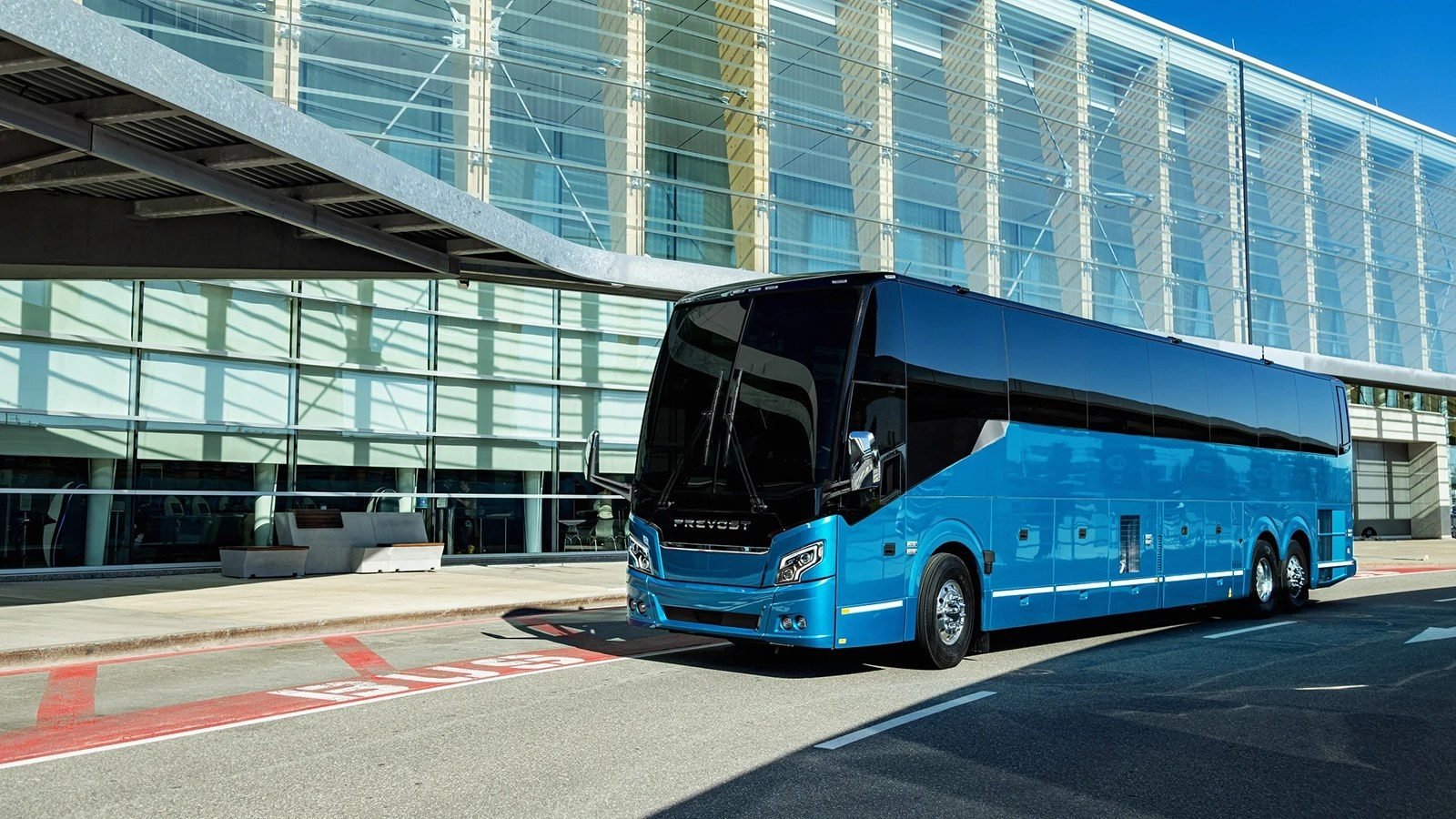

Prevost, the Quebec coach builder owned by Volvo Group, has unveiled the H3-45 Electric, its first battery-electric motorcoach. It gets a 540 kWh Volvo battery, 450 kW (600 hp) from two electric motors, and both CCS1 and MCS charging as standard.
The H3-45 is Prevost’s flagship and one of the most common highway coaches in North America. Prevost is pitching the electric version as the same coach drivers and technicians already know, with a different powertrain.
Prevost first committed to an electric coach back in April 2022, when it announced a five-year electrification program backed by the Quebec government. That plan included a 100% electric coach and a retrofit kit to convert existing diesel coaches. The coach is now here. Prevost hasn’t said anything new about the retrofit kit.

A Volvo powertrain in a Prevost body
Everything that moves the coach comes from Volvo. Prevost’s product page describes a single drive unit that combines two electric motors, an 8-speed automated manual transmission, and an oil retarder, rated at 450 kW (600 hp). Prevost’s tagline for it is “more power than diesel.”

The gearbox is the interesting part. Volvo’s own BZR Electric coach chassis in Europe uses a 2-speed automated transmission, but a 45-foot North American coach spends most of its life at highway speed and on long grades, and more gears help keep the motors in their efficient range. Prevost claims 97% motor efficiency across the working range, and drivers get adjustable regenerative braking for descents.
540 kWh, but 459 kWh usable
The battery system is made of six Volvo Cube2 units on a 600V architecture, for 540 kWh of total capacity. The brochure specifies 459 kWh of usable energy “across the full battery life,” so Prevost is holding back about 15% as a buffer.

The packs are liquid-cooled and IP6K9K-rated, and they use the same VCS2B coolant as the diesel H3-45. Volvo also backs every battery for refurbishment, second life, or recycling.
Prevost rates the coach at “up to 250 miles (400 km)” of range. But the footnote under that number says typical energy use runs up to 2.25 kWh per mile (1.40 kWh/km).
Do the math with Prevost’s own figures: 459 kWh of usable energy at 2.25 kWh/mile is about 204 miles, or roughly 328 km. Reaching 250 miles requires averaging about 1.84 kWh/mile. So 250 miles is the best case, and operators should plan around closer to 200 miles before keeping any reserve for the return to the depot.
Also, an energy buffer of almost 80 kWh is quite massive.
CCS1 and MCS, both standard
On a CCS1 charger at up to 350 kW, a 20-80% charge takes about 55 minutes, according to Prevost. The Megawatt Charging System (MCS) cuts that to about 35 minutes. The charge port is positioned for pull-through truck-stop stalls, and Prevost says no adapter is needed on public networks.

Those numbers also tell you how fast MCS actually charges this coach. Going from 20% to 80% of 459 kWh means adding about 275 kWh. Doing that in 35 minutes averages roughly 470 kW. That’s a lot faster than CCS1, but nowhere near a megawatt.
The value of MCS here is access as much as speed. Megawatt chargers are being built for electric semi trucks, like the first MCS truck charge in North America at EV Realty’s San Bernardino hub, and newer dispensers like Kempower’s dual CCS and MCS charger serve both connectors. A coach that can pull into those stalls has a lot more charging options on the highway.
Same coach, different powertrain
The rest of the spec sheet reads like a regular H3-45: up to 52 passengers, Cloud One Premium seating, Prevost Driver Assist, LED headlights, five monitors, automatic tag-axle unload, and a kneeling system. 360-degree cameras and a winter package are optional.

Prevost markets the coach as a certified zero-emission vehicle and leans hard on grant eligibility in its brochure. There’s one catch in the fine print. The optional cold-weather heater is diesel-fired, and it produces emissions when it runs. For Canadian and northern US operators, that’s probably the option most of them will tick.
Prevost didn’t include pricing or a delivery date in its announcement. Jay Menard, who runs Prevost’s ZEV programs, told Electric Autonomy that pilots start in early 2027 and that production deliveries should begin around mid-August 2027.
Five years behind MCI
Prevost isn’t first here. Its main North American rival, MCI, unveiled its J4500 CHARGE electric coach in 2021 with a 544 kWh battery and more than 200 miles of rated range. So Prevost is arriving about five years later with essentially the same battery size.
What Prevost brings is a single-OEM drivetrain from Volvo, more power, a multi-speed gearbox, and MCS. It also keeps the electric version on the same platform as the diesel H3-45. And Prevost confirmed in September that its 2027 Volvo D13 diesel meets the new EPA and CARB standards. The diesel H3-45 isn’t going anywhere.
For more electric bus and coach coverage, check out our electric buses guide.
If you drive an EV, powering it with home solar can cut your fuel costs to nearly zero. With electricity rates up almost 10% last year and expected to keep climbing, going solar is one of the best ways to protect yourself against rising costs. And with lease and PPA options, you can do it with zero upfront cost and start saving immediately. If you want to find the best deal, check out EnergySage. It’s a free service with hundreds of pre-vetted installers competing for your business, so you save 20 to 30% compared to going it alone. No sales calls until you pick an installer. Get your free quotes here.


FTC: We use income earning auto affiliate links. More.
