



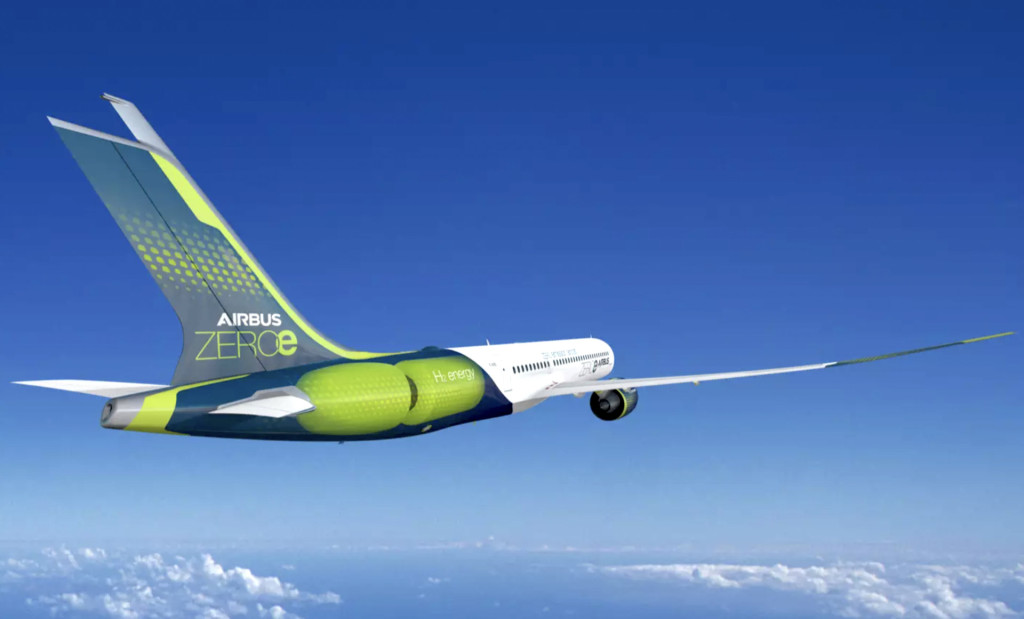
Airbus recently announced that it’s planning to design, build, and demonstrate a “megawatt-class propulsion system” intended for a large-scale passenger aircraft, featuring hydrogen fuel-cell tech with cryogenic hydrogen storage, in less than four years.
This doesn’t mean that a hydrogen fuel-cell jumbo-airliner is on the way in that timeframe, or that the company sees fuel-cell tech as a complete replacement for jet engines. But it might replace some jet engines on a smaller scale well before the internal-combustion engine is completely banished from cars.
The company says it “could be tested in flight by the middle of this decade—around 2026,” and it calls hydrogen “a very compelling option” in the company’s quest to bring zero-emission aircraft to market by 2035.
As the company outlines, it has effectively three options with hydrogen. It can burn the hydrogen in modified gas turbine engines; it can use hydrogen fuel cells to create electrical power; or it can use some combination of both.
For any of these paths, it could (as explained as part of the video below) produce hydrogen from renewable energy like wind and solar, but going the fuel-cell-EV route means that such planes would effectively be zero-emissions.
If holding cars to a higher standard, why not planes?
That would help solve an inconvenient truth—that cars, trucks, and buses aren’t the only transportation emissions issue. Commercial air travel accounts for about 2% of greenhouse gas emissions globally or, in the U.S., more than 3% of GHG emissions and about 10% of total transportation emissions. If automobile emissions can make strong progress with electrification, why can’t aircraft makers step up their game?
That’s partly because the other inconvenient part is this: current automotive battery technology isn’t yet as energy-dense as it would need to be to fly long commercial routes or larger planes. Even hydrogen storage will need a new kind of solution to tap into the energy density an aircraft needs.
Airbus, in these recent announcements, says that the craft will incorporate a cryogenic hydrogen storage tank, operating at -253 degrees Celsius. Storing the hydrogen at a very high pressure of 700 bar would not be enough, it says, but at temperatures that cold hydrogen becomes a more energy-dense liquid. Even then, four liters of liquid hydrogen are the equivalent of just one liter of standard jet fuel, Airbus says. So don’t expect range rivaling a Boeing 777 or Airbus A350 quite yet.
Airbus liquid H2 tank
Safety and durability requirements are tighter than they might be for space launchers, Airbus says, as commercial aircraft would need not only to endure 20,000 takeoffs and landings but would need to hold the liquid hydrogen for longer. For that solution, it’s working on a composite-materials approach.
The fuel-cell demonstrator has many steps yet to go in development and testing. It will be built on Airbus’ A380 MSN001 “multi-modal test platform” and will be modified externally so as to carry the fuel-cell engine pod. Airbus is partnering with automotive supplier Elring Klinger and is in a joint venture with that company called Aerostack for the fuel-cell stacks, which generate electricity (plus a little water and heat) from hydrogen through a closely managed electrochemical reaction.
It’s likely, just as in fuel-cell cars like the Toyota Mirai, that a lithium-ion battery pack will play a role in helping to buffer energy—or in this case, to provide emergency descent if the stack shuts down.
It’s not over yet for fuel cells’ role in ground transport
Such solutions may fit in well with a future in which big-picture research suggests fuel cells could have a big future in aviation, shipping, and heavy industry—while the window of opportunity for fuel cells may be fading fast for many truck and bus formats.
In the meantime, both Airbus and Boeing are reportedly continuing work on new-generation hybrid engines that may electrify the turboprop. And smaller firms have completed short flights of electric commercial aircraft.
In the U.S. aircraft weren’t yet subject to any greenhouse gas standards until 2020, when the U.S. EPA added them for new commercial planes and large passenger jets after years of industry resistance. It’s feasible to see a time when the regulatory frameworks will usher in more stringent goals, so until things like teleportation or high-speed tunneling become a reality, innovating the jumbo-jetliner may be the way to save its existence.
