


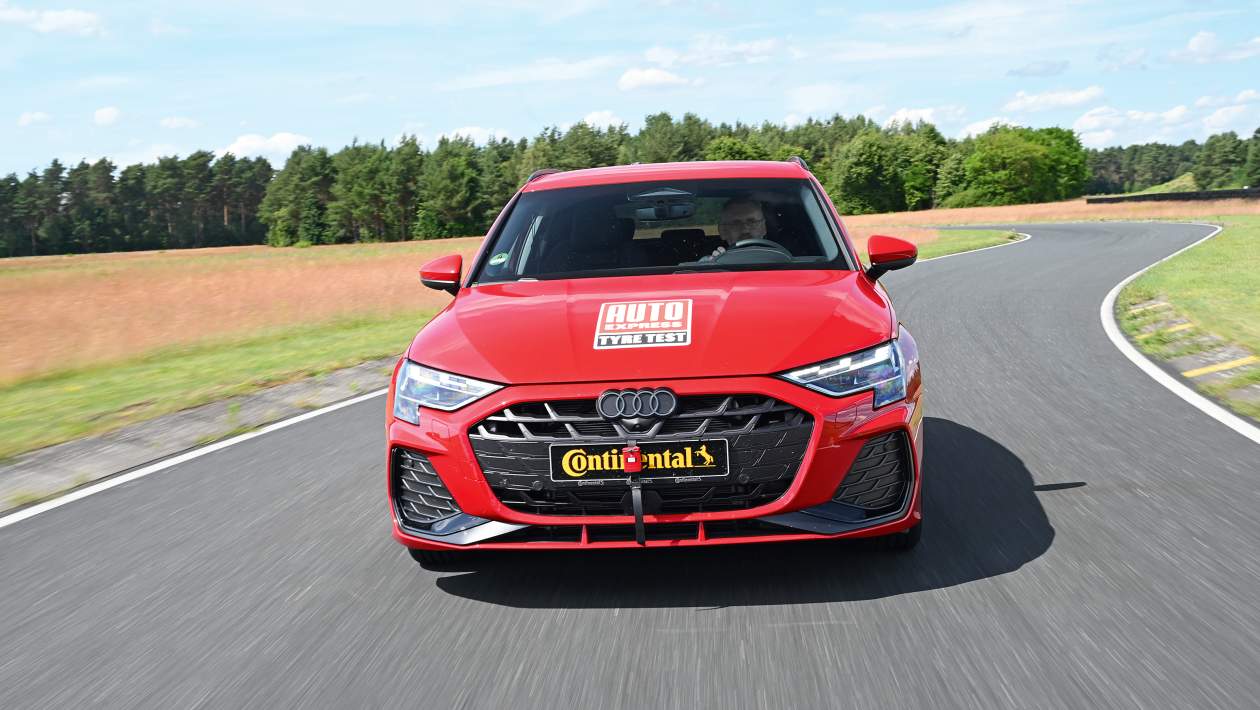
There are also two aquaplaning tests. In the straight-line test we measured the speed at which each tyre was generating 15 per cent of slip in 9mm of water. Resistance to aquaplaning when cornering was tested by driving a curve flooded with 5mm of water over a speed range from 40 to 60mph and then calculating the average amount of residual lateral acceleration.
Dry
Straight-line dry braking performance was measured from 62mph to zero. We also took lap times on a one-mile, dry handling circuit that combined a range of turns, from traction-testing slow corners to sweeping bends and sequences that challenged each tyre’s grip, dynamic balance and traction, plus composure under braking, too.
Noise
New tyres carry an EU tyre label that includes a rating of the noise it generates, but this is an external, drive-by measurement. Instead, we use a meter to measure the level of noise the driver and passengers hear inside the vehicle over a variety of specially prepared smooth and coarse surfaces at a set speed.
Fuel economy
The energy required to simply roll a tyre over a surface – its rolling resistance – influences the fuel economy of your car. The tyre label carries the rating of the tyre from A (good) to E (poor), but these are bands and represent a range. We test the tyres to the same industry standard and deliver a more accurate result. As a rule of thumb, a four per cent change in rolling resistance is equivalent to a one per cent change in fuel consumption.
Prices
These are sourced from online retailer Blackcircles.com and show the cost of a fitted tyre at the time of writing. Price has a limited impact on the overall result to the tests, because tyres are a safety-critical item.
Calculating a winner
Half of the overall score is allocated to wet performance and 40 per cent to dry, with the emphasis on braking and handling in both instances. The remaining 10 per cent is shared among the other tests. The top-performing tyre in each criteria evaluated is scored at 100 per cent, with the others rated relative to this.
