


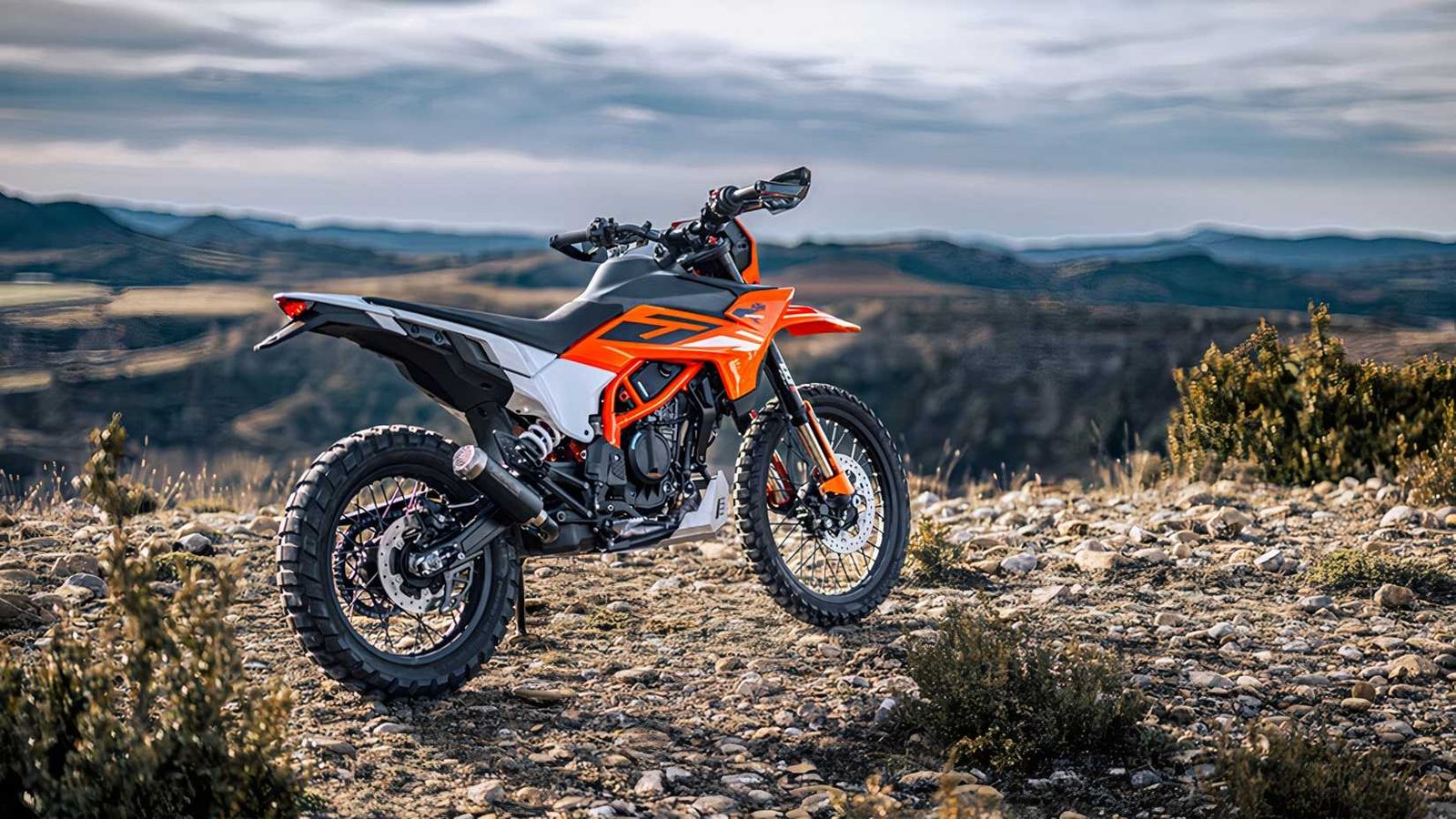
Driving a car is simple because it asks very little of you: you steer, you step on the gas, and you hit the brakes. The car stays upright on its own, leaving you free from having to think about physics. Getting on a motorcycle is the complete opposite. Suddenly, you have to balance on two wheels, manage a clutch friction zone, pick the right gear, and watch out for painted road lines, gravel, cold tires, and rain. On top of that, you are wearing gear for the first time—heavy boots, an armored jacket, and a helmet, none of which feels natural. To make matters worse, motorcycles do not work the way your brain expects them to: the slower you go, the more unstable the bike feels and the more it wants to fall over. For a beginner, just getting out of a parking lot is pure information overload.
Why Traditional Dual-Sports Intimidate Beginner Riders

Experienced riders often tell beginners to learn in the dirt because falling off on trails hurts less and teaches great bike control, but that advice throws newcomers right into the deep end. Dual-sport motorcycles make the most sense for this, but they come with a built-in problem: off-road ground clearance.
To clear rocks and logs, manufacturers make these bikes extraordinarily tall, regularly pushing seat heights past 34 or 35 inches. They might be lightweight, but that means very little when you come to a stop at a red light and cannot get your feet on the ground. When you combine that intimidating height with a long, rock-hard bench seat, a basic dual-sport ends up testing a rider’s nerves instead of teaching them how to ride.
Honda Leverages Global Commuter Expertise To Build A Better Trainer

Fixing this problem takes a company that understands everyday utility rather than showroom numbers. Honda is the biggest motorcycle manufacturer in the world, and while it can build incredible technical showcases like the Gold Wing, that is not where it makes its real numbers.
The bulk of its business comes from selling small, indestructible commuter bikes to millions of people in Southeast Asia, Africa, and South America: places where people rarely have access to a formal riding school and simply need a motorcycle that works without scaring them. That background makes Honda uniquely qualified to design an entry-level bike focused entirely on building rider confidence.
The Solution: The Accessible $5,749 Honda CRF300LS

The CRF300L was always the perfect new bike for first riders, and the $5,749 Honda CRF300LS fixes the biggest intimidating factor of the dual-sport class by taking away the fear of not being able to reach the ground for no extra charge over the regular CRF300L. Honda brought the seat height down to 32.7 inches, over two inches lower than the standard model, and offers it right from the showroom floor with the factory warranty.
It keeps the smooth, low-maintenance 286 cc single-cylinder engine and light clutch, but pairs them with ergonomics that let newer riders put their boots flat on the dirt. Instead of chasing paper specs, it gives beginners the control they actually need.
Friendly 286cc Liquid-Cooled Thumper Delivers Usable Low-End Grunt

The CRF300LS gets a 286 cc single-cylinder engine with liquid cooling and four valves that is simple, durable, and versatile. It is a slightly short-stroke design with a compression ratio of 10.7:1, and it generates 27 horsepower at 8,500 RPM and 19.6 pound-feet at 6,500 RPM. It has Honda’s PGM-FI fuel injection and puts the power down through a six-speed manual gearbox with an assist and slipper clutch.
This is not a peaky engine, preferring instead to spread the torque evenly through the rev range. There are no ride modes; instead, a simple cable throttle does duty, but to be honest, with just 27 horsepower, you do not need ride modes. The assist and slipper clutch will be appreciated by new riders.
Low 32.7-Inch Seat Height And Light Curb Weight Build Instant Rider Confidence

The CRF300LS is built for both dirt and daily life, featuring a steel semi-double-cradle frame with an aluminum swingarm. These are paired with 41 mm inverted Showa forks at the front with 9.3 inches of travel, and nine inches of travel is provided by the preload-adjustable Pro-Link monoshock at the rear. This is a couple of inches less compared to the regular CRF300L. The same is true of the ground clearance, which is 9.6 inches—still more than enough for a beginner. The suspension is paired with a 256 mm front brake disc with a two-piston floating caliper and a 220 mm rear disc with a single-piston caliper.
The brakes are mounted on a 21-/18-inch spoke wheel combination fitted with tube-type tires that are capable of admirable grip in the dirt. This is not a very large bike, with a length of 87 inches and a width of 32.2 inches. The seat height is a very approachable 32.7 inches when considered in the context of a dual-sport bike. It also weighs 311 pounds wet and holds 2.1 gallons in its fuel tank. This is a reasonably light motorcycle with a low seat and decent ground clearance, which means dabbing a foot in the dirt or putting one down at a stoplight will not be a problem for someone spending their first few days on a motorcycle.
Functional Running Gear Keeps Complexity To A Bare Minimum

This is an affordable motorcycle that is designed for a first-time buyer, which is why it does not have what one would think of as a completely modern set of features. The instrumentation consists of a rectangular LCD display that offers a lot of information, including the fuel level, revs, speed, a clock, gear indicator, odometer, trip meters, and even average speed. Oddly enough, coolant temperature is not shown on the display.
The handlebar is a dirt-style unit with a cross brace, which should help if you ever drop it. All-LED lighting is a welcome addition, as is dual-channel ABS that is switchable at the rear and is now standard. This is one of the few dual-sports that offers hooks allowing you to tie down luggage to the pillion seat. The accessories list has handguards, an enduro skid plate, and a USB port, among other things. In short, it features most of what a new rider needs to get an understanding of riding before taking on something that requires more skill.
Source: Honda PowerSports
