


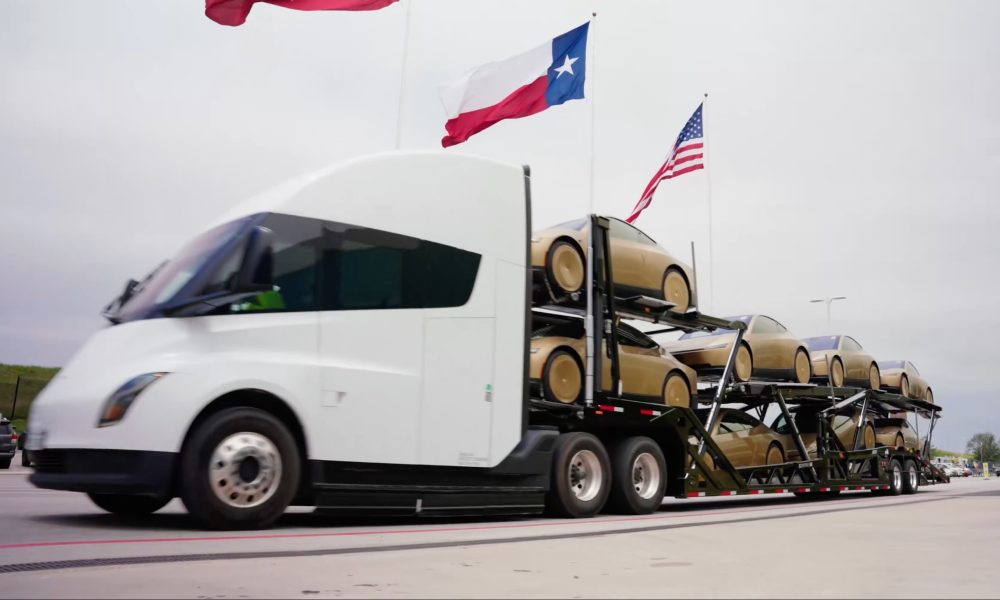
Although the two vehicles are built for completely different use cases, Tesla utilized engineering expertise while developing both the Cybercab and Semi to build a thermal architecture that would fit both vehicles. Of course, with some slight revisions.
The development was noted by Lars Moravy and Dan Priestley last week at Tesla’s Semi Handover event in Sparks, Nevada, where the company showed off its dedicated production facility for the Class 8 truck.
🚨 Tesla designed the integrated thermal systems for Cybercab and Semi at the same time as the vehicles were both in development
Tesla wanted to build one thermal system that worked with both vehicles, apart from small modifications.
Semi and Cybercab share parts 🤯 pic.twitter.com/KmzSsUbrcg
— TESLARATI (@Teslarati) September 25, 2026
Tesla’s decision to develop one thermal architecture for both the Cybercab and Semi is one of the more revealing engineering choices in the company’s 2026 lineup:
“We designed it at the same time we designed the Cybercab and we said okay we’re going to take our most efficient vehicle and our biggest vehicle and we’re going to take one thermal system and make it work for both.”
Core parts, meaning the compressor, pumps, and heat exchangers, are shared, with only modest changes to cooling-loop sizing and a larger radiator on the truck. The result, they said, is a compressor and thermal stack already proven across millions of miles, delivering “reliability from day one.”
Priestley also highlighted a practical payoff of the indirect design:
“There’s no AC lines, there’s no refrigerant lines…It comes from the factory fully charged, sealed with refrigerant, and it just exchanges coolant. It doesn’t actually run refrigerant up to the front of the vehicle.”
This eliminates potentially leak-prone plumbing that would otherwise require hands-on service, reducing overall uptime and potentially cutting into business margins. The megamanifold runs cabin HVAC and every powertrain heating and cooling loop at once, recapturing waste heat from motors and the battery instead of dumping it the way a diesel engine does.
The approach is just the latest chapter in a continuing story of stretching thermal solutions across wildly different vehicles. Model Y’s Octovalve evolved into the Super Manifold used on Cybertruck, and later Model S/X refreshes. Cybercab then introduced Supermanifold V3, which Tesla says is 80 percent automated to build and 38 percent more efficient than typical automotive thermal systems.
This thermal system is also shared with Cybercab – one thermal system for both our most efficient vehicle & our biggest vehicle
— Tesla Semi (@tesla_semi) September 25, 2026
Tesla has done the same with the 4680 cells, both being utilized in the Cybertruck and Semi, and with heat-pump compressors that Priestley noted were already common across the passenger-car fleet.
Concurrent development of crucial vehicle elements buys scale and reliability that a truck-only thermal system could not match. High-volume passenger car parts are cheaper and more accessible, which can give fleets a sealed, low-maintenance loop of operation from their first day of operation.
For owners and operators, that translates into less energy spent on cabin heat in the colder months, fewer refrigerant-related repairs, and a thermal architecture already stress-tested at passenger-car volumes before the first high-volume Semi left the lines in Nevada.
