


There’s also something of a novelty to how Nissan has laid out the dashboard, because it doesn’t follow any of the current European design trends. There’s no centre console, for instance, and the dash-mounted gear selector and compact collection of controls are grouped right up by your knee.
The other overwhelming aspect inside is a colossal sense of open-ness. Despite the car’s narrow width, there’s loads of leg and headroom in the second row. The boot doesn’t offer much floor space, but because it’s a tall shape, it’s still pretty spacious.
In part due to the electric powertrain and tiny 14-inch wheels, if you measure interior space versus external size, there can’t be many more efficient options here in Europe.
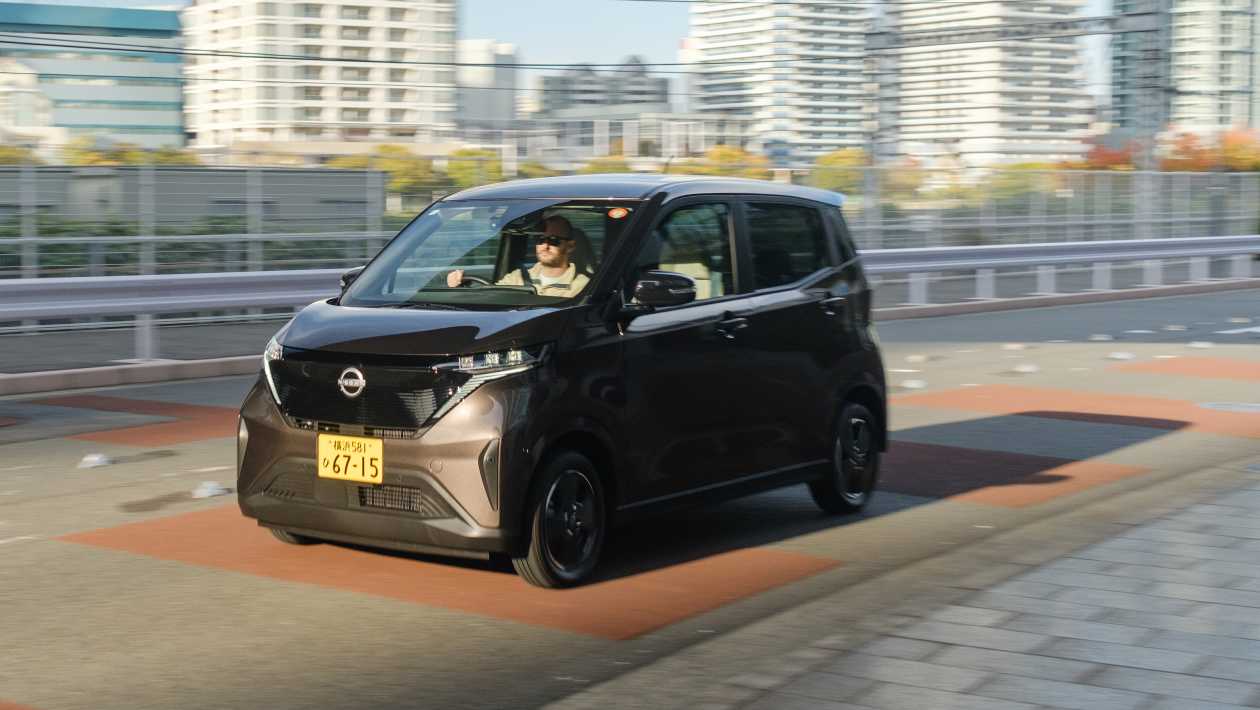
Driving in ultra-tight residential streets in Yokohama, it’s a cinch to zip down alleyways with plenty of room to spare for pedestrians and cyclists. This might sound like an overly specific experience, but anyone who’s driven down a medieval British village lane or a London back-street will appreciate the advantage of having such a narrow car.
Otherwise, the driving experience is similar to just about any other small EV, with quick-witted responses and an agile feeling. The Sakura doesn’t produce much power – just 63bhp, in fact – but its comparatively huge 195Nm makes it feel considerably more pokey than petrol-powered European city cars. The surprise is how well it’s all calibrated, and how much the set-up suits the incredibly upright stance. There’s no lurching or jerky stops, and its regenerative braking feels just as powerful as in any modern EV.
Under the floor, Nissan’s 20kWh battery pack is small, while less-than-ideal aerodynamics resulting from the car’s shape limit its range to 112 miles, but in town or between villages, this could be plenty for anyone with easy access to charging. The Sakura will also top up relatively quickly, taking around 40 minutes to get from 0 to 80 per cent capacity.
