


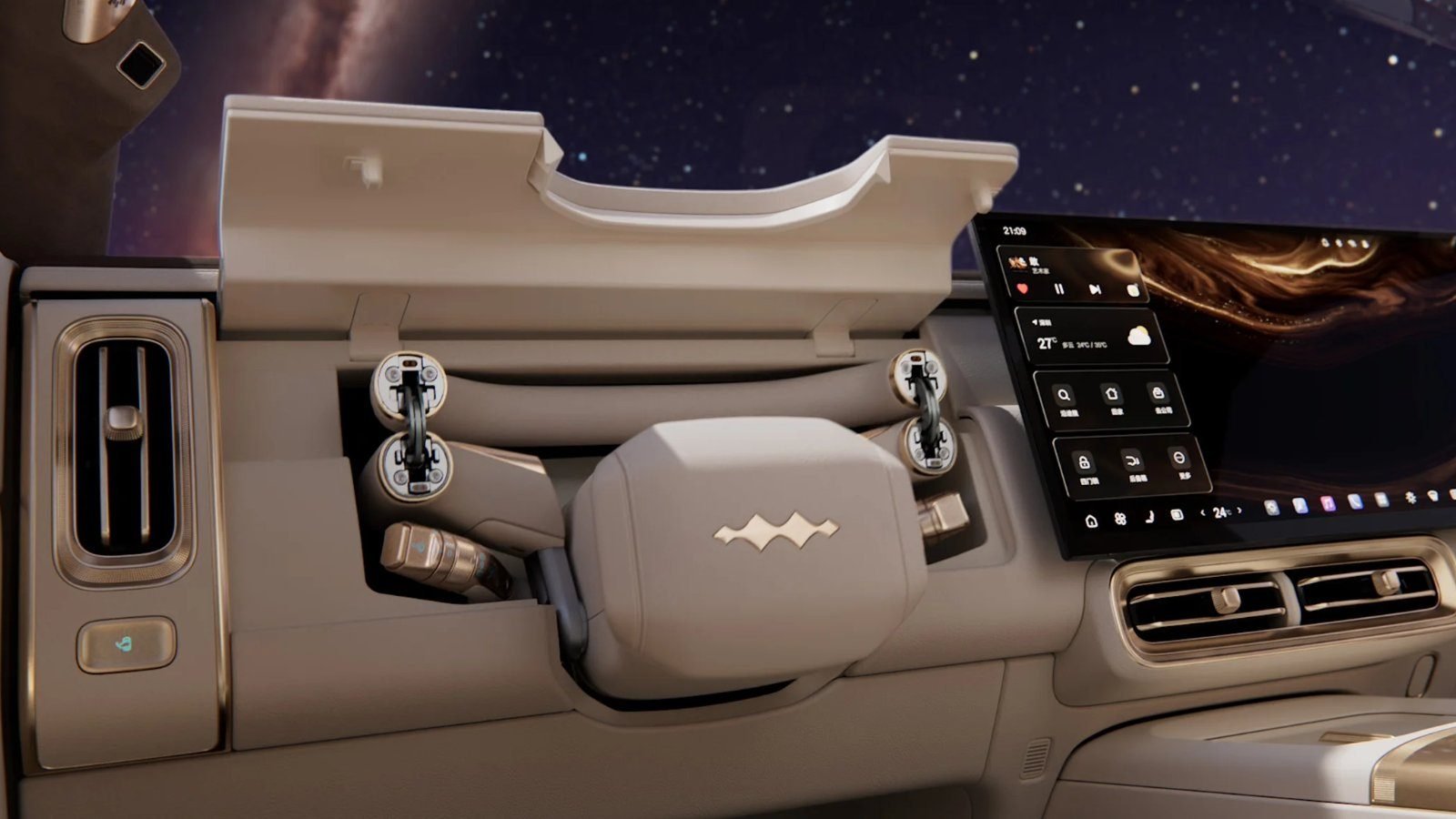

BYD launched a production SUV today with a steering wheel that folds flat into the dashboard. It comes standard on the top trim of the Fang Cheng Bao Tai 9, which sells for 329,900 yuan (about $49,000) in China.
Automakers and suppliers have been parading folding wheels on concept cars for about a decade. This is the first one customers can actually order, according to BYD.
How BYD’s folding steering wheel works
The whole thing hinges on steer-by-wire. There’s no steering column physically connecting the wheel to the front wheels, so the wheel is just an input device, and BYD can put it wherever it wants.

On the Tai 9, it swings through 180 degrees on a hidden hinge and drops into a compartment in the dash in about 10 seconds. A panel closes over it, and a tray table folds out where the wheel used to be. Only the airbag remains outside of the compartment – keeping it useful with the steering wheel deployed or hidden.

It only folds when the vehicle is parked. Fang Cheng Bao pairs it with a driver’s seat that reclines to 165 degrees, so the pitch is simple: fold the wheel, lie back, and eat, nap, or play games while you charge or wait. The brand claims 80% of the driver’s area becomes usable space and rates the folding mechanism for 80,000 cycles.
When it’s deployed, it’s a regular D-shaped wheel with a full rim and physical buttons. No yoke. That’s a nice change from Tesla and Mercedes, which paired its new steer-by-wire system on the EQS with a yoke.

At the launch event, Fang Cheng Bao general manager Xiong Tianbo said the industry had been talking about folding steering wheels since 2016 without ever getting one into mass production. He added that BYD is using the same type of motor it develops for humanoid robots to move the wheel, a first in one of its cars.
Here’s Fang Cheng Bao’s official video of the feature:
Why it’s happening now
China’s new national standard for steering systems took effect on July 1, 2026. It dropped the long-standing requirement for a mechanical link between the steering wheel and the road wheels, as long as the system meets redundancy and fail-safe rules.
Before that, steer-by-wire needed special approval. Nio’s ET9 was the first car in China to get it, back in December 2024. In the US, Tesla’s Cybertruck already uses it, and Mercedes is bringing it to the EQS this year.

Folding wheels themselves have stayed on show stands. BYD’s own Denza brand showed one on the Z concept at Shanghai in 2025. Autoliv and Tensor called theirs the “world’s first foldable steering wheel” at CES in January, for a Tensor Robocar they expected to reach volume production in the second half of 2026. Hyundai Mobis has been showing one for years.
Tesla went the other way with the Cybercab: no wheel at all. But the prototypes testing on public roads have a Cybertruck steering wheel bolted onto an exposed column, because a human still has to be able to drive.
The rest of the Tai 9
The Tai 9 is Fang Cheng Bao’s biggest SUV yet. It’s 5,270 mm (207.5 in) long with a 3,130 mm wheelbase and six seats in a 2+2+2 layout. It’s also the first model on BYD’s new DMS hybrid platform.
A 1.5-liter turbo engine works with front and rear electric motors for a combined 400 kW (536 hp), and 0 to 100 km/h takes 4.8 seconds. The 66.48 kWh second-generation Blade battery supports BYD’s flash charging and delivers 310 km (193 miles) of electric range on the WLTC cycle. Rear-wheel steering, LiDAR, and BYD’s God’s Eye B driver assistance system are standard.

There are three trims: 279,900 yuan (about $41,700), 299,900 yuan, and 329,900 yuan. Only the top one gets the folding wheel.
Fang Cheng Bao sold 43,872 vehicles in October, up 41% year-over-year, mostly on the strength of the Tai 7. That model is now heading overseas: BYD sells it in the UK as the Ti 7. BYD hasn’t said anything about exporting the Tai 9.
Electrek’s Take
We’ve seen this at pretty much every auto show since the mid-2010s: a steering wheel slides away so the “driver” can relax while the car drives itself. It never shipped, for many reasons, but with steer-by-wire and autonomous driving now becoming reality, BYD is making the jump.
The Tai 9’s wheel only folds when you’re parked, so right now it’s a lounge feature. Recline the seat, stow the wheel, flip out the tray, and watch a movie while you charge. Is that a gimmick? A little. But Chinese EV buyers spend a lot of time in parked cars, and fridges, screens, and lie-flat seats sell cars there for a reason.
The bigger deal is underneath. The wheel can only fold because the Tai 9 is steer-by-wire, and BYD is putting that in a roughly $49,000 family SUV less than five months after China made it legal. After Cybertruck and now Mercedes with the EQS, we might be seeing the first steps of steer-by-wire actually becoming a more widely adopted technology.
If you’re buying an EV, powering it with home solar can cut your fuel costs to nearly zero. With electricity rates up almost 10% last year and expected to keep climbing, going solar is one of the best ways to protect yourself against rising costs. And with lease and PPA options, you can do it with zero upfront cost and start saving immediately. If you want to find the best deal, check out EnergySage. It’s a free service with hundreds of pre-vetted installers competing for your business, so you save 20 to 30% compared to going it alone. No sales calls until you pick an installer. Get your free quotes here.


FTC: We use income earning auto affiliate links. More.
