


Unless you’re getting an instant cash offer for your vehicle or selling it to someone you already know, you’ll probably be putting it up for sale online. This will involve deciding where to list the car, preparing it for sale, interacting with potential buyers, and then finalizing the sale.
Here’s the step-by-step process for selling a car online.
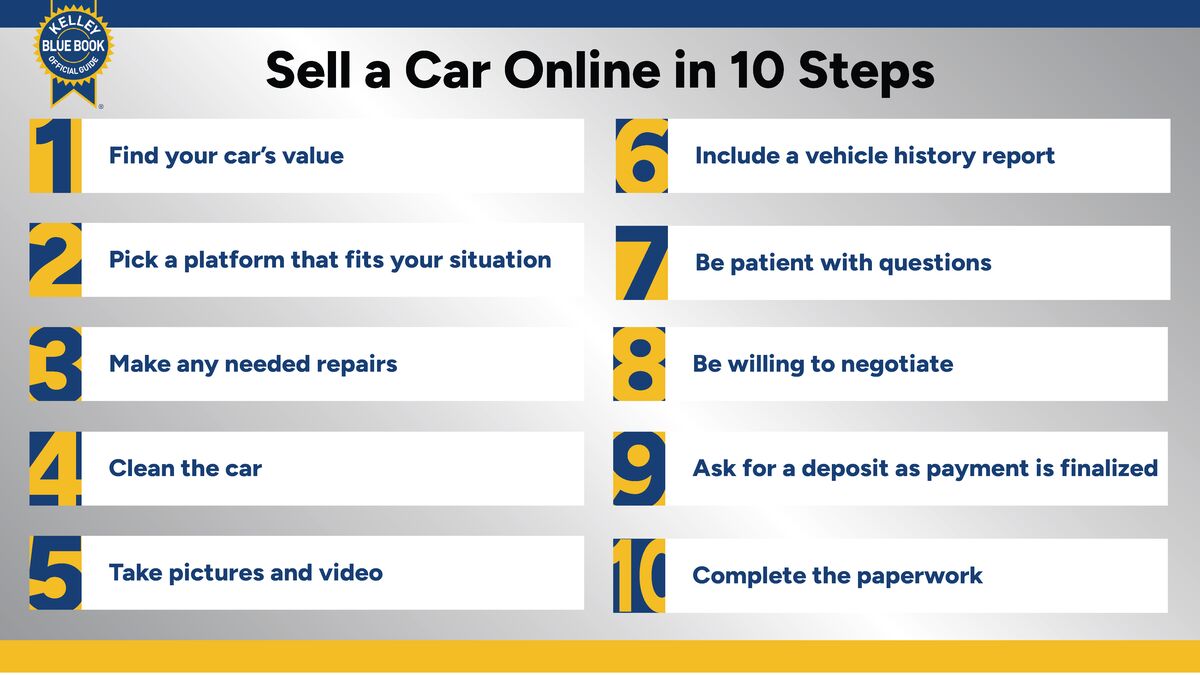
Selling a Car Online: Step by Step
Step One: Find Your Car’s Value Before Selling Online
Knowing what your vehicle is worth is the first step to a successful sale. Having a value will help you understand how to more effectively sell your car online by asking for a reasonable amount. It will also help you determine if an auction-style sale might be better than listing it privately. Checking its value on Kelley Blue Book will tell you how much the vehicle is worth on the private market, in a dealer sale, or through a trade-in. You will need to have the vehicle’s VIN or license plate to check its value.
There’s also an Instant Cash Offer tool that allows dealers to make an offer on your vehicle, essentially setting a floor on your asking price. You can determine whether the extra money you might be able to get on the private market will be worth your time and energy in advertising, showing, and eventually selling your ride.
Step Two: Pick a Platform That Fits Your Situation
Where you choose to list your vehicle will depend on the car itself and how much you want to invest in the process. If you’re selling a run-of-the-mill, slightly beat-up 10-year-old commuter car, you might opt to head to Facebook because the listing is free, there are no fees after the sale, and you can post many pictures. Craigslist, also free, used to be the go-to. However, it now tends to be a magnet for scammers. Know that with either of these options, you’ll probably spend more time wading through responses to find legitimate buyers. If you have a rare or higher-value car or truck, an auction-style listing with a site like Cars & Bids or Bring a Trailer can help you maximize your sale price.
Using a site like Kelley Blue Book or Autotrader can help eliminate scammers from the equation. Both sites, owned by parent company Cox Automotive, offer ways to sell used cars to dealerships and private parties through Private Seller Exchange. These sites offer clear listings with filters for buyers to find exactly what they’re looking for.
LEARN: 7 Ways to Protect Yourself When Selling a Car Privately
Step Three: Make Repairs
No one wants to pay thousands for a busted car. Attending to the basics, like replacing bald tires, repairing the brakes, and doing away with the cracked windshield will do a lot to ensure that you get top dollar for your car.
Be especially sure to fix safety-related items like brakes, steering, and lighting components. If the car needs a major repair that you don’t want to make yourself, you need to be honest with the buyer. A diligent car shopper will request a pre-purchase inspection, and any issues will be revealed there.
Step Four: Clean the Car
No one wants to buy a dirty car. If you don’t have time to clean the interior and wash and wax its exterior, pay to have someone else do it. Even if you’re selling a $1,500 car, a detailing job can make a big difference when it comes time for the buyer to fork over the cash and seal the deal.
There’s no excuse for posting photos of litter-strewn carpeting and coffee-stained seats in a vehicle. It doesn’t show well, even on the internet, and it will deter reputable buyers.
Step Five: Take Lots of Pictures and Video When Selling Online
Online car shoppers want to see your vehicle from every angle, inside and out. Video is becoming more standard for car listings as well. Video allows sellers to show buyers a thorough walk-through of the car, and can help whittle down prospective buyers to only those who are very interested in next steps.
As mentioned earlier, make sure the car is clean. Try to snap your photos in a place with even lighting. Shooting photos after dark is a no-go. Taking pictures beneath bright sunlight can make for harsh shadows in the picture. Choose a spot with a plain background (a blank concrete wall or empty parking lot can be good). Avoid places where trees, poles, and other objects will lay shadows across the image.
Be sure to show multiple angles of the vehicle. A good rule of thumb is to get shots of all sides. Take photos of the front, front 3/4 (that’s an oblique angle) driver’s side, back, back 3/4, and passenger’s side. Also, show the front and rear seats, the dash, the trunk, the engine compartment (which may require a flash), and the undercarriage. If your ad says “rust-free,” be ready to prove it. Some people won’t even consider looking at your car in person until they’ve seen an exhaustive catalog of online photos and video.
Step Six: Include a VIN Report with Your Listing
Buyers want to know all details of the car up front, and a vehicle history report using the vehicle identification number, or VIN, will help. You can and should include a report with your listing, though many buyers will also want to obtain one themselves, depending on the site where the car is listed. With the VIN, they can use AutoCheck to obtain vehicle history reports.
Any wise buyer will obtain a vehicle history report so that they can see the car’s maintenance record and if it has any title brands, like salvage or rebuilt.
Step Seven: Be Patient with Questions When You Sell Online
Most potential buyers will have many questions, some of which photos or a VIN report won’t answer. Be patient with these questions. A vehicle is a major purchase, and buyers need to do their due diligence. Getting frustrated with them for this isn’t helpful for anyone.
Be ready to provide a solid answer for the most telling question of all: Why are you selling the vehicle? If you don’t have a good answer, you may scare away someone who’s otherwise willing to buy it.
Step Eight: Be Willing to Negotiate
When you list a vehicle, most buyers will assume that there’s some wiggle room on the price, and you should expect that they will try to negotiate.
One way to get around this is by asking for a slightly higher price (but not too high, lest you scare off buyers). Most buyers will feel better about the sale if you’re able to take — at the very least — a few hundred bucks off of your initial price.
Don’t sell yourself short, but a little flexibility can go a long way and lead to a quicker sale.
Step Nine: Ask for a Deposit as You Finalize Payment
When you’re selling your car online for cash, you don’t want someone to commit to buying, only to have them renege after you’ve already removed the listing. So, to protect yourself, ask for a deposit. How much depends upon the price.
A good rule of thumb for less expensive cars and trucks is $500, but asking for 50% or better of the final buying price is a perfectly acceptable practice.
For your deposit and the sale itself, electronic payments like Venmo, Zelle, and PayPal are more common than ever. However, it’s best to check the terms of payment limits for the service you plan to use. Easy payment options can help finalize a cash sale before the buyer has second thoughts. The faster you get the buyer’s money, the more quickly you complete the deal.
Some sellers (and buyers, for that matter) prefer cash transactions. So, it can help to be open to other options, including cashier’s checks.
MORE: Best Ways to Exchange Funds in a Car Sale
Step 10: Complete the Paperwork
After payment, the only thing remaining is to finalize the paperwork. You will need to sign over the title to the buyer, filling out the mileage and sale price.
Some states require that the DMV be notified of the sale within a certain timeframe and a Notice of Transfer and Release of Liability form be completed. Others require a Report of Sale form. Some states, like California, have different requirements for whether or not the license plates stay with the vehicle. Be sure to check the requirements for your specific state.
The final thing to do is notify your insurance company of the sale. The last thing anyone wants to do is continue to pay for insurance for a car they no longer own.
Visit our Car Selling and Trade-In Information Center for in-depth resources about every aspect of selling or trading in a car.
Editor’s note: Article has been updated since its initial publication. Benjamin Preston contributed to this report.
