


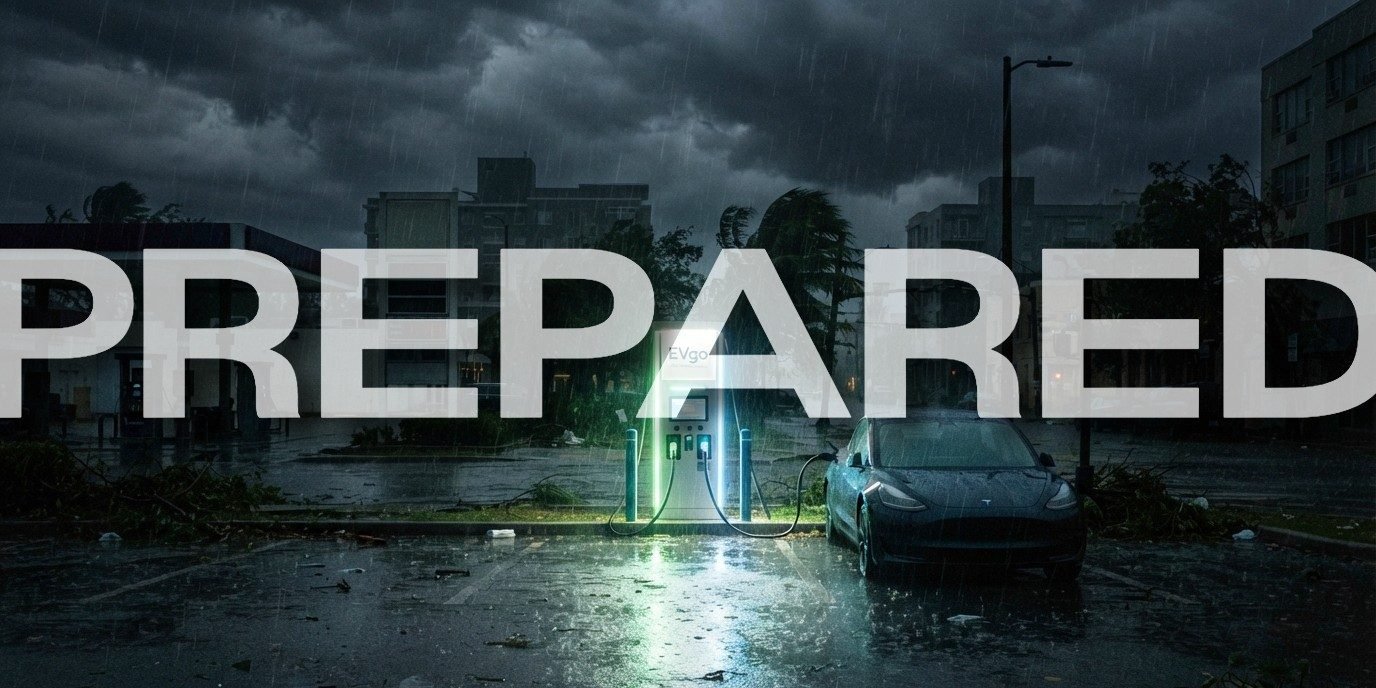

The luddites like to question the capabilities of EVs in emergency situations, but gas cars aren’t immune to disaster, either. Panic-buying can wipe out local fuel supplies in hours, and when the power goes down, gas pumps go down right along with it. That knowledge begs the question: what’s the most resilient choice – gas, or electric fuel?
“Do you have an ‘end-of-the-world’ charging plan?” wrote Redditor AshesT0Aces, asking a question that many would-be electric vehicle drivers have probably asked themselves. “Serious question for EV owners: If there’s a widespread power outage or grid failure, what happens to the Supercharger network?”
As the latest in a long line of dumb oil wars rages on and the mercury remains above a balmy fifty degrees (!) in Chicago (!!) on Thanksgiving weekend (!!!), the whole “prepper” lifestyle seems less and less loco these days – so it makes sense to take the question seriously and try to think our way through a few scenarious.
Fortunately, we don’t have to use our imaginations too much to see how electric vehicles handle a real-world grid collapse because we already have receipts from real EV driver who weathered (sorry) real recent storms. One Redditor going by PedalingHertz responded to AshesT0Aces with a story about how their EV was the only vehicle that could find fuel anywhere in the aftermath of Hurricane Helene.
The day after hurricane Helene hit, I drove from Montgomery, AL to Titusville, FL, in my Sierra EV stopping in Vidalia, GA to help out family. I was towing a flat bed auto transport with an SUV on top. That meant I crossed the entire southern end of the state of Georgia when the power was out for all but the edges.
I passed endless gas stations that were shut down. No power to run the pumps. For at least 100 miles outside of Vidalia, no gas. I had topped off the truck at a Buccees in in Warner Robbins, so I was good to continue either way, but I was looking for chargers anyway.
In Vidalia there is a Ford dealer with both DCFC and 19.2kw Level 2 chargers. The DCFC was offline because it uses 120v lines to run the electronics (just like a gas pump). However, the level 2 chargers worked great! Seems their power lines are underground and separate from the others. They use their own main 240v supply to power the electronics, so no issue there. I topped up to 100% before continuing on, just in case.
Made it down to Titusville, dropped off the trailer, bought a generator (which could not be found for sale in the impact zone), and returned with it + several cans of gas for family to use the remaining 3 weeks until power was restored. Crossed Georgia again going the other way to get home. That place was an absolute disaster. I’ve lived through many hurricanes and never seen it so bad.
As handy as PedalingHertz’ GMC Sierra EV was in a scenario where gas just wasn’t available, it could be even more valuable in a scenario where the gas has run out – and probably won’t be coming back anytime soon.
In that scenario, even a gas-powered generator won’t help keep the lights on. An EV owner, however, has options. Options that range from having solar panels baked into the car’s roof or folded up to be carried around in the bed of an electric truck. But, if you’re really prepared, you’ve already gone way beyond that. You’ve already installed an entire energy generation, storage, and distribution system at your home base.
Energy dominance
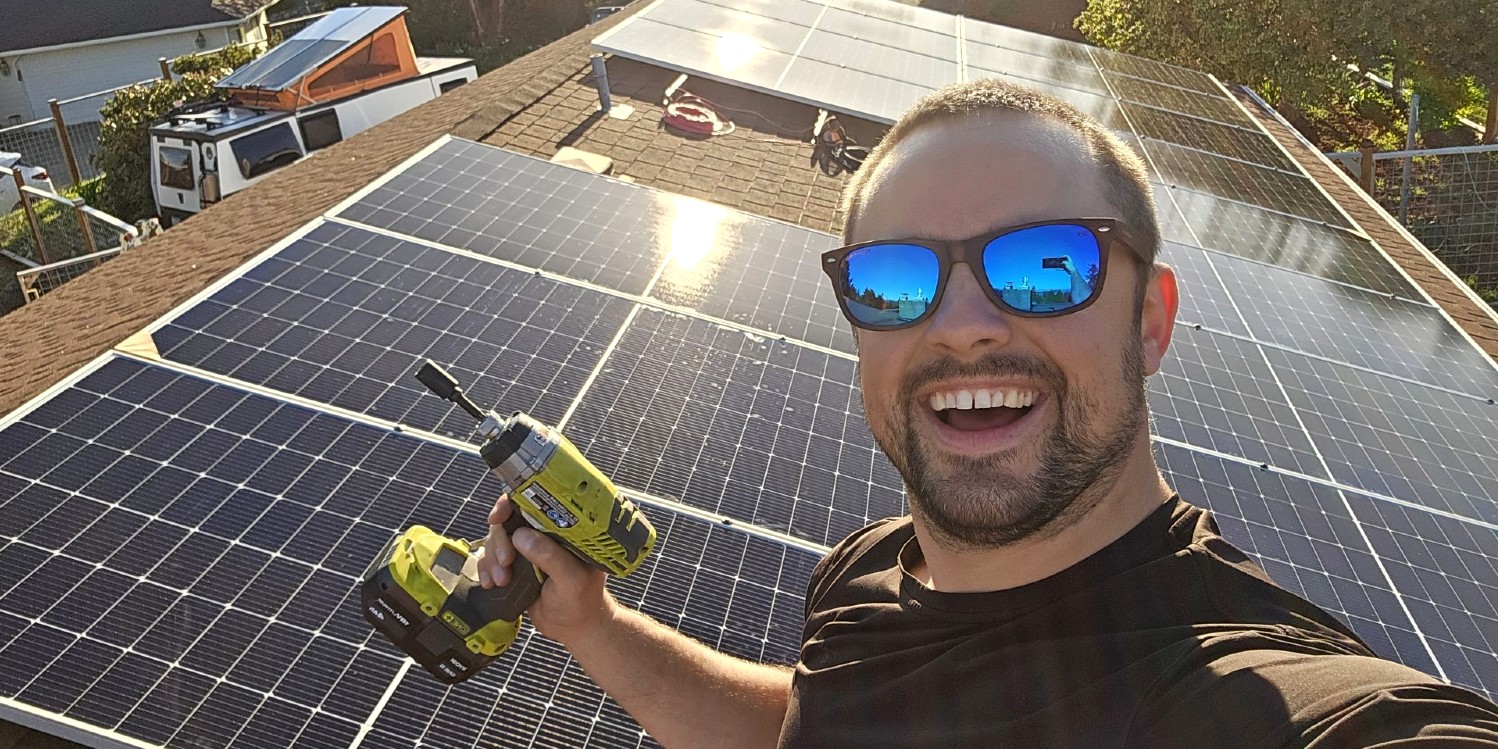
Back in April, microgrid expert and GM Energy employee Jim Reilly shared his personal experience with a whole home electrification setup that includes both a GM Energy home backup battery and a GMC Sierra EV powered by electrons generated by his rooftop solar array. It’s a setup he said went beyond energy independence, giving him, “Energy Dominance.”
As Reilly points out, the real benefit of pairing an EV with a home solar system is the ability to make your own fuel, whether the world is imploding around you or if everything is humming along as-is. And, even then, the whole-home energy setup can help EV owners can set the price of their electric fuel by selecting when they want to charge, when they can, and storing the most affordable energy in their batteries for use later.
“For anyone driving on gasoline, there’s nothing to do here but pay,” writes our own Editor-in-Chief Fred Lambert. “A combustion car gives you exactly one option: the pump. When a drone hits a pipeline halfway around the world, that’s your problem, and your only move is to hand over more money at the station.”
In a real emergency, the price you can expect to pay for gas will be a lot higher than whatever it is you’re paying now.
What do you guys think – does electric fuel genuinely offer the post-apocalyptic benefits over ICE that we think they do, or is there some massive advantage for gasoline power that has eluded us? Head on down to the comments and let us know.
Original content from Electrek.

If you’re considering going solar, it’s always a good idea to get quotes from a few installers. To make sure you find a trusted, reliable solar installer near you that offers competitive pricing, check out EnergySage, a free service that makes it easy for you to go solar. It has hundreds of pre-vetted solar installers competing for your business, ensuring you get high-quality solutions and save 20-30% compared to going it alone. Plus, it’s free to use, and you won’t get sales calls until you select an installer and share your phone number with them.
Your personalized solar quotes are easy to compare online and you’ll get access to unbiased Energy Advisors to help you every step of the way. Get started here.


FTC: We use income earning auto affiliate links. More.
