


Quick Facts About Inflatable Seat Belts
- Some used vehicles from the 2010s have inflatable rear seat belts.
- Inflatable seat belts are designed to spread crash forces over a larger area of an occupant’s torso.
- If you use a child car seat or booster, check both the vehicle and child restraint manuals for compatibility.
If you’re shopping for a used vehicle, you may encounter inflatable seat belts in some Ford, Lincoln, Mercedes-Benz, and Lexus models.
These belts contain a small airbag that inflates during certain crashes to spread restraint forces across more of an occupant’s torso than a conventional seat belt. The main consideration for used-car buyers is whether the belts are compatible with a child car seat or booster.
Mercedes-Benz also continues to offer its Beltbag inflatable rear seat belts as optional equipment on select 2026 and 2027 S-Class models.
What Are Inflatable Seat Belts?
Ford introduced inflatable rear seat belts on the 2011 Ford Explorer and later expanded the technology to several Ford and Lincoln models. Mercedes-Benz and Lexus also used versions of inflatable belts.
The airbag is built into the shoulder portion of the belt. In a qualifying crash, it inflates to distribute restraint forces across a larger area of the passenger’s chest and torso.
RELATED: Child Car Safety Seats — Things to Consider When Choosing a New Car
How Do You Identify Inflatable Seat Belts?
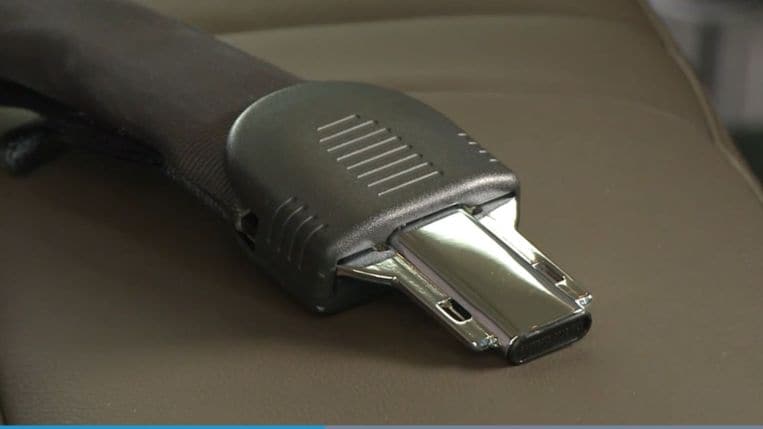
Inflatable belts are generally thicker than conventional seat belts because the airbag is built into the webbing. They may also use a distinctive buckle or metal connector. Some Ford belts are labeled “Inflatable Belt.”
Because availability varied by model year and trim, verify the equipment on the individual vehicle rather than assuming every example of a particular model has them.
Are Inflatable Seat Belts Safe?
Inflatable seat belts were designed as a safety feature, helping distribute crash forces over a larger area of the body.
Other rear-seat restraint technologies include pretensioners, which tighten the belt during a crash, and load limiters, which allow some controlled belt movement to reduce forces on the chest. Rear-seat adoption of these technologies has varied by vehicle.
MORE: Read curated articles from Kelley Blue Book’s car seat coverage.
Can You Use a Car Seat With Inflatable Seat Belts?
Sometimes. Compatibility depends on both the vehicle and the child restraint.
Some child seats cannot be installed with inflatable belts because the thicker webbing may not fit properly through belt guides, lockoffs, or other components.
Before installing a child restraint with inflatable seat belts:
- Check the vehicle owner’s manual.
- Check the child car seat or booster manual.
- Follow the installation method approved by both manufacturers.
In some cases, you may be able to use the vehicle’s LATCH lower anchors instead of the seat belt. However, lower-anchor use has weight limits, so follow the instructions for both the vehicle and child restraint.
MORE: How Rear-Seat Dimensions Affect Car Seat Fit
Which Vehicles May Have Inflatable Seat Belts?
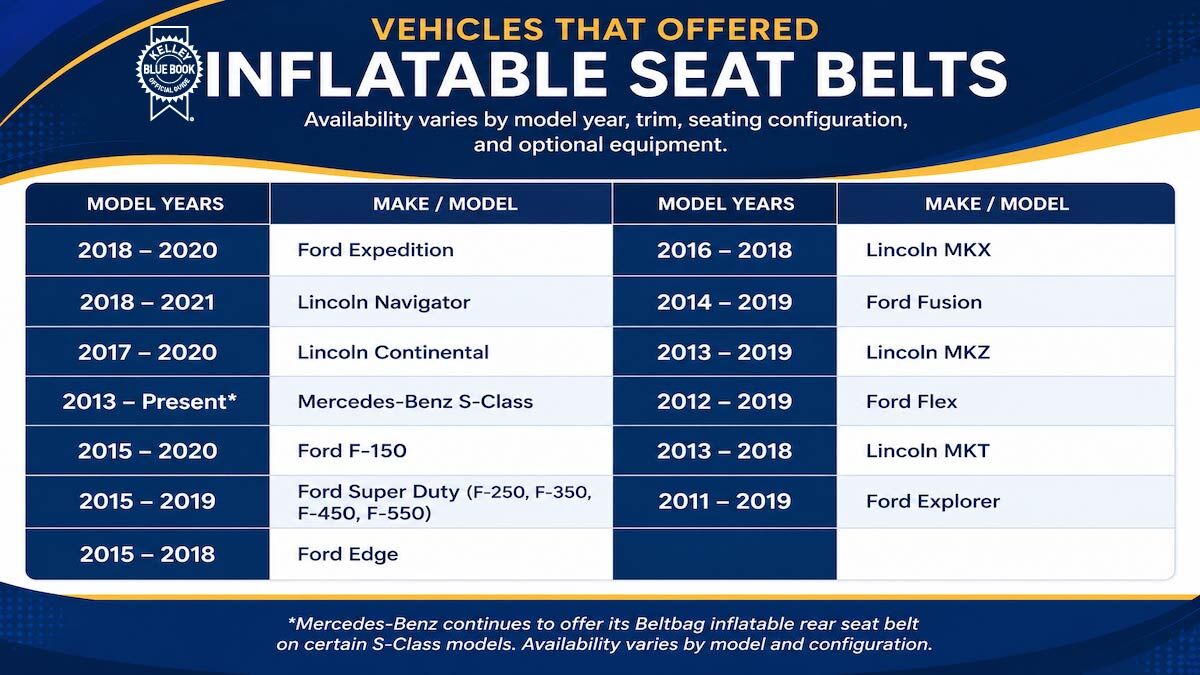
Ford offered inflatable rear seat belts on several vehicles during the 2010s, including versions of the:
- Ford Explorer
- Ford Flex
- Ford Fusion
- Ford Taurus
- Ford Edge
- Ford F-150
- Lincoln MKT
- Lincoln MKZ
Mercedes-Benz also used inflatable rear belts, marketed as Beltbags, in the S-Class. The technology remains available today: Mercedes-Benz offers Beltbag inflatable rear seat belts as optional equipment on select 2026 and 2027 S-Class models.
Lexus also used inflatable belt technology in the LFA.
Availability varied by model year, trim, and seating position. If inflatable belts matter to you, particularly because you’ll be installing a child restraint, verify the equipment on the individual vehicle.
What Should Used Car Buyers Do?
Inflatable seat belts don’t need to be a deal-breaker. Before buying a vehicle equipped with them:
- Check compatibility with any child seats or boosters you plan to use.
- Read the vehicle owner’s manual for installation instructions.
- Check the VIN for outstanding safety recalls.
- Inspect the belts for damage or evidence of previous deployment.
If an inflatable belt has deployed in a crash, it must be replaced.
For most shoppers, inflatable seat belts are simply another feature to understand. For parents and caregivers, confirming child-seat compatibility before buying is the key consideration.
Editor’s Note: We have updated this article since its initial publication.
