


Many truck owners will consider a lift-kit upgrade at some point during their ownership. Lift kits are one of the most popular modifications for truck owners, and offer changes in ground clearance, off-road capability, and aesthetics. As with any modification, however, there can be downsides. Before investing in a lift kit, we encourage drivers to do their own research and consider their own driving conditions.
Types of Lift Kits
Lift kits come in two types: body lift kits and suspension lift kits. Both increase the distance between the vehicle’s body and the ground, but they do so in different ways.
Body Lift Kit
The simplest and most affordable path to lifting a truck is with a body lift kit. To find a body lift kit that works for your vehicle, you need to first understand how truck bodies are constructed.
Trucks such as the Chevy Silverado 1500, Ram 1500, and Ford F-150 are body-on-frame vehicles. In this case, assembly involves attaching a separate body to a steel frame and chassis. On the other hand, cars, crossovers, and some pickup trucks, like the Honda Ridgeline, have unibody construction, in which the body and frame are manufactured as a single unit.
Body lift kits can only be installed on vehicles with body-on-frame constructions since the lift occurs between the frame and body. A body lift kit typically includes spacers that you insert between the frame and the body. This type of lift kit raises the center of gravity, making the vehicle more prone to tipping. You should carefully consider whether your truck is top-heavy, especially if it’s an off-road vehicle.
Body lift kits also do nothing to increase a truck’s ground clearance between the undercarriage and the driving surface. Although they are less expensive to buy and install, they can only raise a truck’s body from 1 to 3 inches.
Pros and Cons of Body Lift Kits
Here are a few advantages and disadvantages of body lift kits.
| Pros | Cons |
| Cost – Relatively affordable. Think $400 to $800. | Installation – It requires unbolting the body and then lifting it off the frame. |
| Installation – Compared to suspension lift kits, they’re also relatively simple to install. | Looks – The factory bumpers don’t raise with the body in nearly every body lift kit. Moreover, a body lift may expose more of the frame. |
| Tires – If the goal is to accommodate larger tires, they’re a sensible way to do it. | Ground Clearance – Any ground clearance gained will be due to the taller tires if you choose to add them. |
| Looks – Raising a truck, even a little, can add to its curb appeal. | Handling – Lifting a truck does not improve performance and may make a vehicle more prone to tipping by raising the center of gravity. |
| Towing – Your truck’s towing capability or safety shouldn’t be affected by a body lift kit. |
Suspension Lift Kit
Suspension lift kits are more expensive and complicated to install. However, they can raise a vehicle by more than a foot.
Unlike a body lift kit, a suspension lift kit raises the body and frame relative to the axles. A suspension lift kit always increases the suspension height, but different kits will achieve this in various ways. Most suspension components will be replaced, such as control arms, shocks, and leaf springs. Depending on how high you want to raise your vehicle, you may need to replace steering components as well.
These changes contribute to greater wheel articulation, larger tires, and increased ground clearance, which can all enhance off-roading prowess.
Spacer Lift
Another method for lifting the suspension is to insert spacers between the top of the shock absorber and its chassis mount. Unlike a full suspension lift kit, they don’t increase ground clearance. Spacer lifts aren’t the best choice if extreme off-roading is your goal because they can cause the coil springs to compress beyond a safe limit.
Pros and Cons of Suspension Lift Kits
Here are some benefits and disadvantages of suspension lift kits.
| Pros | Cons |
| Height – You can raise your truck as high as you want, within reason, if you spend enough money on an aftermarket kit. | Cost – The price of an aftermarket suspension lift kit depends on how high you want to raise your truck. You could be looking at $1,000 to $20,000. |
| Ground Clearance – A suspension lift kit increases ground clearance and usually provides more wheel articulation required for extreme off-road rock crawling. | Convenience – Lifting a truck 6 inches or more could make getting in and out of the cab a hassle. |
| Tires – In most cases, you can run much larger tires with a suspension lift than a body lift. | Wear –The driveline experiences additional wear because raising the frame increases the driveshaft angles. |
| Looks – If tall is good, really tall is better. | Towing – You may need to employ a drop hitch to compensate for added height. That will most likely reduce the truck’s maximum towing capability. |
| Insurance – Many kits shouldn’t significantly impact premiums, but some will. | |
| Warranty – If your truck is still under warranty, a suspension lift kit could void some parts of the contract. | |
| Resale – Any vehicle customization makes the seller’s car more difficult. |
Lifted Truck Considerations
Before you jump into the deep end of lifted trucks, you have a few things to consider:
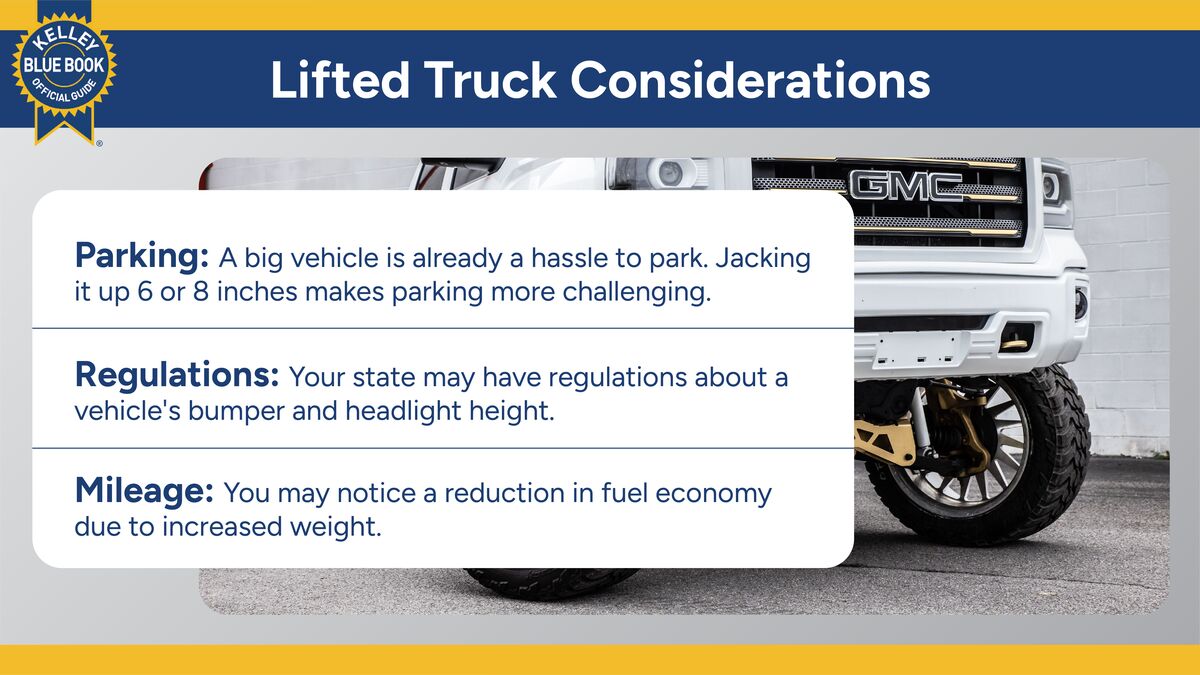
Parking – If covered parking is important, you must know the height limit of your parking garage. Moreover, if you live in a neighborhood with a homeowners association (HOA), it may have rules regarding lifted trucks.
Regulations – Speaking of rules, your state may have regulations about a vehicle’s bumper and headlight height. Unless you plan on trailering your lifted vehicle to off-roading sites, the truck should not exceed your state’s height limits.
Mileage – Lift kits on their own don’t have much impact on fuel economy. However, suspension lift kits can add some weight. You may notice a reduction in fuel economy due to increased weight.
Can You Install a Lift Kit Yourself?
If you shop carefully for your lift kit, it will contain everything you need. Some suspension lift kits don’t include the shocks, which allows you to choose exactly the shocks you prefer. Many shade-tree mechanics can install their own kits successfully, but we don’t recommend it if you don’t have much experience working on cars.
The installation time depends on your mechanical aptitude, experience with lift kits, and the vehicle model you are lifting.
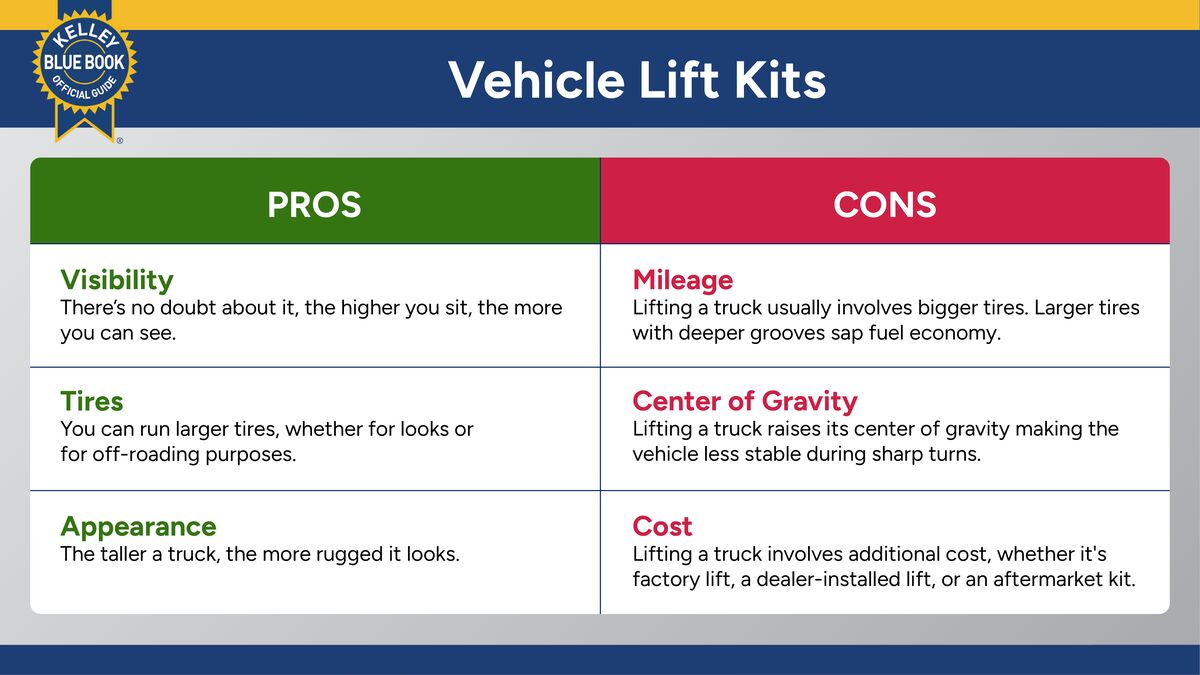
Pros and Cons of Lift Kits
Here are the general pluses and minuses of lifting a truck, regardless of whether you go with a body suspension lift kit.
Editor’s Note: We have updated this article since its initial publication. Russ Heaps contributed to the report.
