


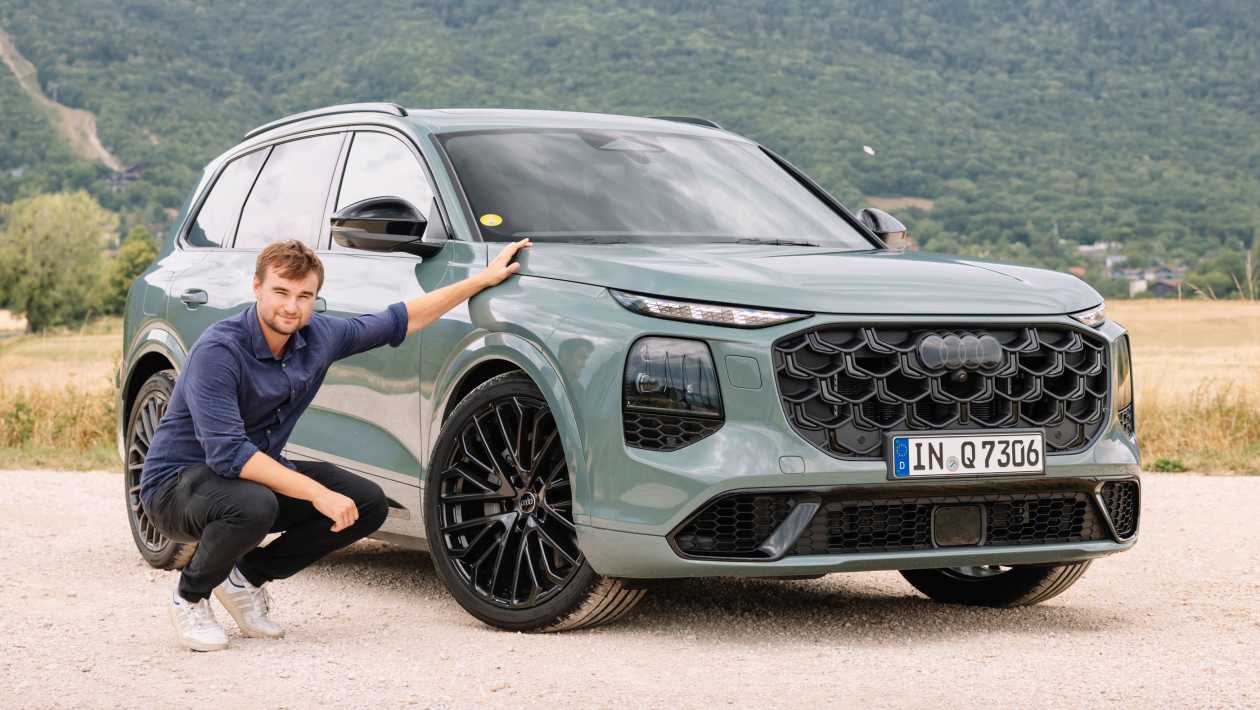
You might think that with extra electrification the new Q7 would be far more economical than the old one. It pumps out less in the way of CO2 emissions than before at 202g/km compared to 217g/km, but the efficiency gains are marginal on paper at 36.6mpg, as opposed to 35.6mpg for the old 282bhp TDI V6.
In the real world we found those figures even closer still, as around town we were lucky to get over 30mpg, with stretches of motorway and B-road increasing this to the mid-30s. The recently facelifted Mercedes GLE in 286bhp 350d diesel form beats the Audi only slightly when it comes to efficiency and emissions, claiming 37.7mpg and 197g/km respectively.
If economy is super important to you, then it might be worth holding out for the Q7 plug-in hybrid. We know it’ll get the same system as the A6 PHEV, meaning a battery capacity of 25.8kWh and an electric range of around 60 miles.
Jump inside the Q7 – which if you go for the mid-spec £88,965 Edition 1 or top-spec £101,665 Vorsprung requires you to use the annoyingly slow electrically opening doors – and you’ll find an interior that’s a clear evolution over that of the old car. It’s quite conservative compared to the BMW X5’s radical dash layout incorporating Panoramic iDrive, and more akin to the Mercedes GLE’s, especially with the three-screen layout, which sees two 12.3-inch displays flank a central 14.5-inch touchscreen.
Audi’s own infotainment system is one of the better ones on the market, with a clear view of key information readily available and rapid response times between various menus and functions. We’re not sure if the loss of the dedicated climate control display from the old Q7 is a good thing, because the tab at the bottom of the touchscreen is a little more difficult to use while driving.
