


According to 2024 data from the U.S. Bureau of Labor Statistics’ Consumer Expenditure Survey, the average consumer unit spent $2,411 on gasoline, or about $201 per month. While this certainly isn’t the largest expense most people will incur, it definitely doesn’t hurt to save on fuel costs, and hybrid vehicles are an excellent solution. But what makes hybrids so gas-efficient, particularly when it comes to city driving?
How Do Hybrid Cars Work?
Hybrids use a traditional internal combustion engine (ICE) alongside at least one electric motor and a battery pack. The electric motor takes strain off the gas-fed engine, which, in turn, helps improve fuel mileage. On local roads rather than on a highway, hybrids can recover energy during braking, shut off the gasoline engine while stopped, and use electric power to propel or assist the vehicle. At low speeds and under light acceleration, many full hybrids can rely heavily on electric power, while the gasoline engine operates when additional power is needed.
City Mileage vs. Highway Mileage: What’s the Difference?
Hybrids improve mileage, though certain variations hold an edge regarding city and highway fuel economy. City driving typically hurts the fuel economy of conventional gasoline vehicles because frequent braking wastes energy and repeated acceleration requires more fuel. Hybrids can recover some of that braking energy through regenerative braking, shut off the gasoline engine while stopped, and use electric power to help the vehicle accelerate. That’s why many hybrids earn higher fuel-economy ratings in the city than on the highway. Knowing which type of hybrid suits your driving needs will help you maximize your mileage.
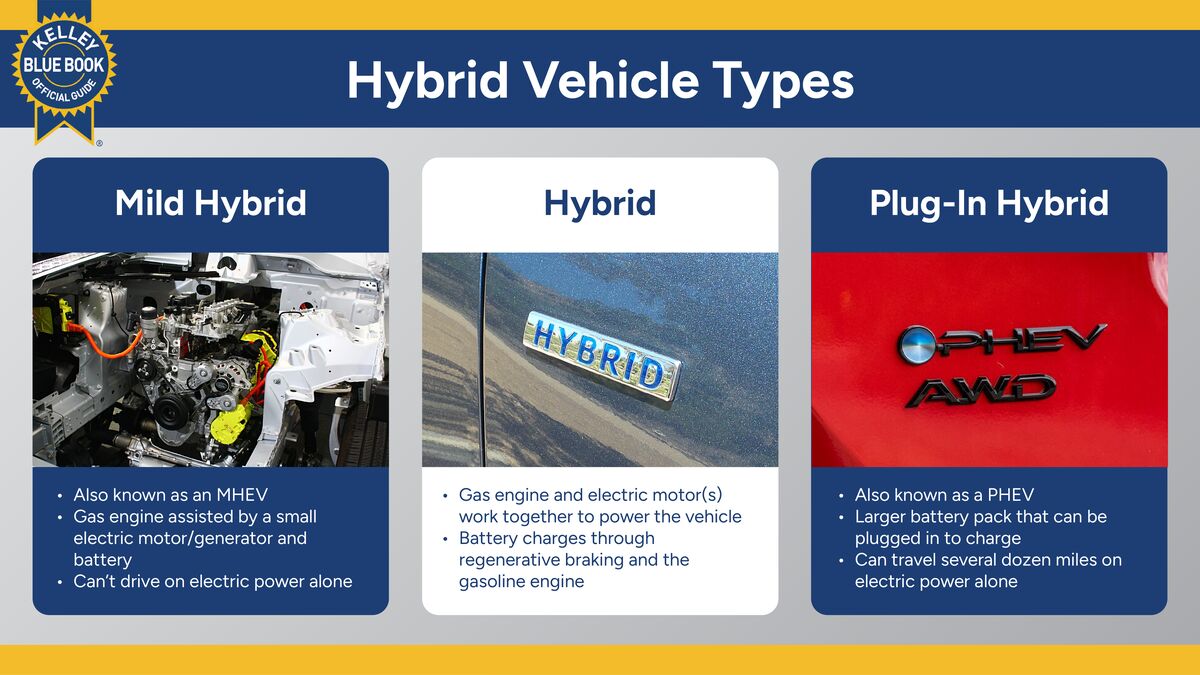
The three main categories of hybrid cars include mild hybrid (MHEV), hybrid, and plug-in hybrid (PHEV). What can make the biggest difference in fuel mileage is which type of hybrid powertrain boosts the vehicle you’re driving. For example, some hybrids can operate solely on electric power, while others cannot.
MORE: What Is MPGe? Everything You Need to Know
Mild Hybrid (MHEV)
A mild hybrid pairs a gas engine with a small electric generator coupled to a compact lithium-ion battery. This adds electric assistance during acceleration and refires the engine using a start-stop system. Unlike a hybrid or PHEV, the electric power of an MHEV can’t fully drive the vehicle, so mileage gains are smaller.
Hybrid
Hybrids, such as the Toyota Prius, use electric motors and battery packs, working with gas-powered engines and shared transmissions. A hybrid keeps its electrical system charged by capturing some of the vehicle’s kinetic energy during deceleration through regenerative braking and converting it into electricity. Hybrids can travel solely on electric power, often only at slower speeds and for short distances.
Plug-In Hybrid (PHEV)
A PHEV has the same general layout as a hybrid. However, it comes with a larger and more powerful battery pack. This allows a plug-in hybrid (PHEV) to travel under electric power for several dozen miles, depending on the make and model. Unlike a regular hybrid, a PHEV must be plugged in to fully recharge its battery pack.
Visit our Car Powertrains Information Center for curated articles on electric vehicle (EV) and hybrid fundamentals, performance, and range insights.
Editor’s Note: We have updated this article since its initial publication.
