


We all love our vehicles, but sometimes our favorite ride can become a little too familiar. Maybe you want to give yours a fresh new look.
Good news: You don’t need a new car to get a new car feeling.
Vinyl wrapping can give your vehicle a dramatic makeover without the commitment of a permanent repaint. You can go bold, keep it classic, wrap the whole vehicle, or just change the hood and mirrors. And when you’re ready for something different? If applied properly, the wrap can be removed to reveal the factory-sound paint underneath.
Think of it as a wardrobe change for your vehicle — same ride, completely different look.
What Is Car Vinyl Wrap?
Car wraps are vinyl films with adhesive backing that you can safely apply to a vehicle’s surface. Unlike a traditional paint job, car wraps can serve as a temporary change. When you’re ready, you can remove the car wrap and return the vehicle to its original finish or try something new.
Providers offer wraps in a variety of finishes. Choices include matte, chrome, gloss metallic, and satin. Wraps are available in many different colors. You may wrap the entire vehicle or choose specific areas, such as the hood, trunk lid, or roof.
Vehicle wrapping is not a quick fix for damaged paint. A peeling clear coat, deep scratches, dents, rust, or poorly adhered paint should be addressed before wrapping. The smoother the surface underneath, the better the finished wrap will perform and look.
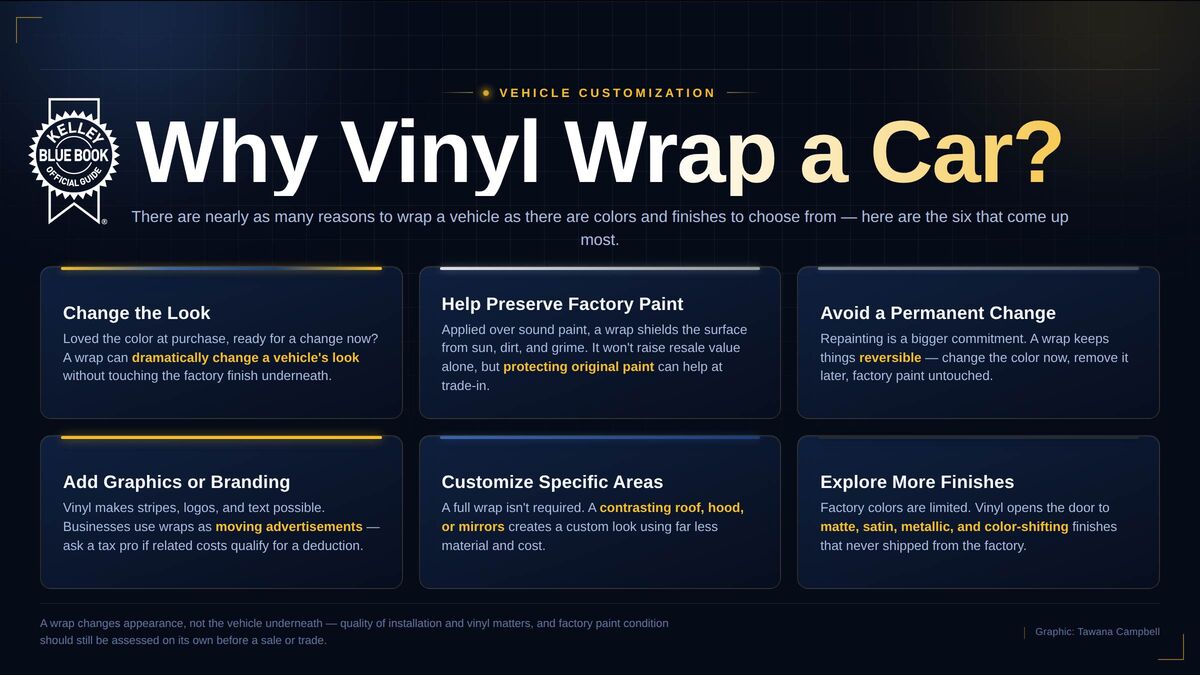
Why Vinyl Wrap a Car?
What Are the Different Types of Vinyl Wraps?
Vinyl film is of two basic types: calendered and cast. In recent years, calendared vinyl has improved significantly and can work for fine or flat panels, partial wraps, or short-term graphics. But for a full vehicle wrap with the creases and curves found on virtually every car, cast is still the better choice, as it conforms more easily and holds up longer.
Cast film is easier to work with and adapts well to the various surfaces found on vehicles. You can easily remove cast film without damaging a car’s factory finish. Make sure to weigh your options before deciding which vinyl wrap will work best for you.
Beyond those two basic vinyl-film categories, providers typically separate wraps into finishes. Depending on the provider, those finishes may be as few as four or as many as a dozen variations. Here are the most likely finish types you’ll encounter.
- Gloss: Essentially a shiny finish, many manufacturers offer different forms of this finish, such as high-gloss, metallic-gloss, and chrome, to name a few.
- Matte: Think of matte as the opposite of gloss. It’s a flat finish that serves to emphasize a vehicle’s shape and contours.
- Satin: This finish is what you might get if you crossed matte with gloss. It’s a matte-like finish with a bit of shine.
- Carbon fiber: Real carbon fiber infuses your car’s appearance with a sense of performance while adding less weight than the metal pieces it replaces. Carbon fiber wraps usually have some texture to enhance their carbon fiber appearance.
- Color-shift: Designed to appear to change color when viewed from different angles and under varying levels of light, color-shift wraps are more of the glossy variety.
