


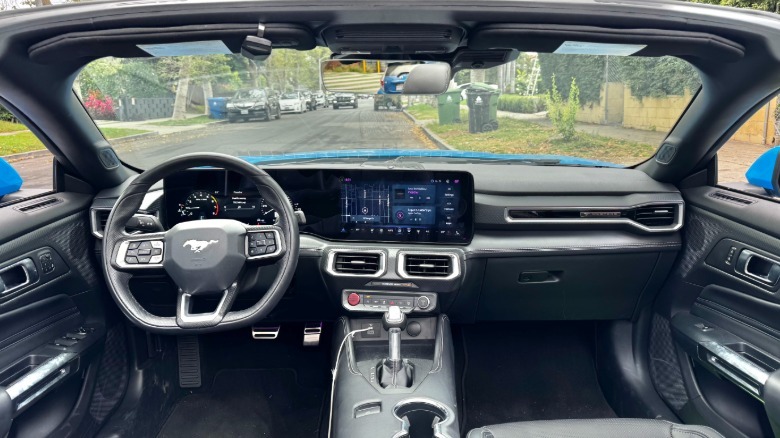
My press car was a 2025 Mustang EcoBoost Convertible Premium, which starts at $44,640 including $1,595 for destination, but my car had a whopping $7,265 in optional extras, so the final price was $51,905. A similarly specced 2026 Mustang EcoBoost Convertible Premium would cost about the same as my 2025 press car, but Ford has yet to announce 2027 Mustang pricing details.
Naturally, my press car was powered by the standard turbocharged 2.3-liter inline-4 engine that produces 310 horsepower and 350 pound-feet of torque, sent to the rear wheels through the standard 10-speed automatic transmission. Ford says Mustang EcoBoost Convertibles weigh a somewhat porky 3,741 pounds, and in Edmunds’ testing, one proved capable of a quick 0-to-60 time of 5.4 seconds.
 Logan K. Carter/ Jalopnik
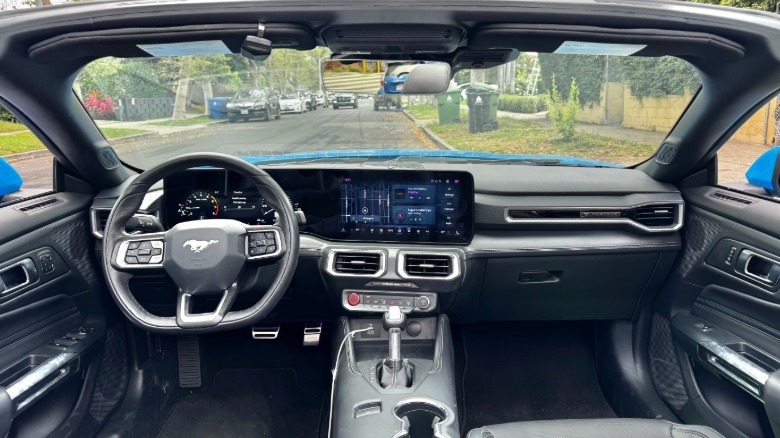
The extra-cost options included the $3,000 Equipment Group 201A, which adds leather seats, a curved display, aluminum pedals, a memory driver’s seat, heated mirrors, a heated leather-wrapped steering wheel, a perimeter alarm, and Ford’s Co-Pilot360 Assist+ that brings a full suite of active safety features like adaptive cruise control with lane-centering and blind spot assist. It also had the $1,450 20-inch aluminum wheels, the $1,225 active performance exhaust, the $995 12-speaker B&O sound system, $395 Grabber Blue Metallic paint, and $200 premium floor liners with mats. It seems like there’s a lot of nickel-and-diming that goes on over at Ford, but I appreciated all the extra-cost features — except for the performance exhaust, which made the EcoBoost engine sound like it had some alarming flatulence at low revs.
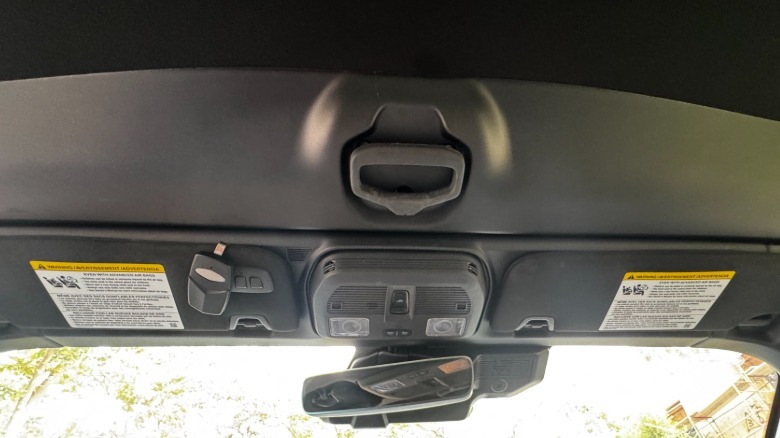
As spec’d, my press car had lots of desirable features, and the interior actually felt higher quality than I anticipated. The center console that was simply a giant layer of hard plastic on older Mustangs was covered in a soft-touch material, which helped elevate the vibe a bit. I wouldn’t describe the interior as being especially luxurious, but it didn’t feel like an economy car either. Still, there were some oddities to it. I was shocked to see that, in the model-year-of-our-lord 2025, my Mustang convertible still had a manual roof latch. My 2005 Saab 9-3 cabriolet had a fully electronic roof mechanism 20 years prior, and the R129 Mercedes-Benz SL had a fully automatic roof in 1989, for goodness’ sake. The manual latch isn’t especially hard to use, but I did not expect to see one on a $50,000 car in 2026.
 Logan K. Carter/ Jalopnik
Despite the horror of having a manual latch, the Mustang EcoBoost convertible is a rarity in the modern automotive market as a relatively affordable four-seat convertible. Its only real competitor is the equally retro Mini Cooper S Convertible, which starts just under $40,000, since the only other four-seat convertibles on the market are the BMW 4 Series convertible and the Mercedes-Benz CLE cabriolet that both start closer to $70,000.
