


SpaceX had an 87 minute window opening at 2:49 p.m. Eastern on Sunday to fly a Falcon 9 out of Cape Canaveral carrying the final three satellites for SES’s O3b mPower constellation, a project that has taken more than a decade to finish since Boeing and SES first signed SpaceX on for the work.
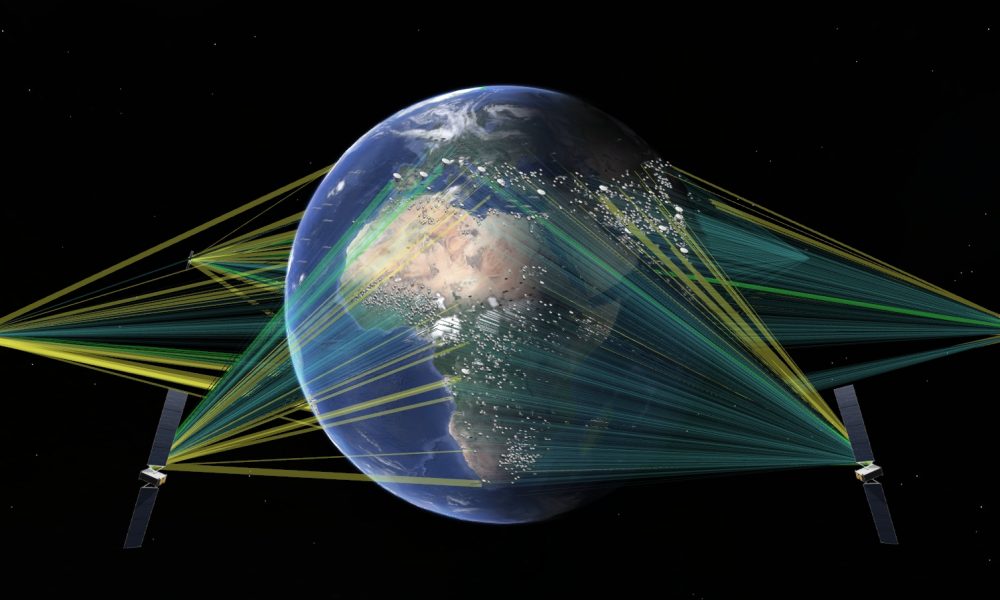
Unlike the thousands of Starlink satellites SpaceX has stacked into orbit over the years, O3b mPower flies in a different neighborhood entirely. The three new satellites, tagged F11, F12 and F13, are headed for medium Earth orbit at roughly 5,000 miles up, more than ten times higher than Starlink’s shell around 340 miles but still a small fraction of the 22,000 miles where old school geostationary satellites sit. That middle position is the whole point, because a satellite that far out needs far fewer siblings to blanket the globe than a low orbit constellation does. Essentially, SES only needed 13 satellites total to build a network offering quick, steady service that used to require thousands of spacecraft.
With most people having heard plenty about Starlink and almost nothing about O3b mPower, SES and SpaceX already blend the two networks for some customers. Both SpaceX and SES sell satellite broadband, but they’re aimed at different buyers. Starlink is built for volume, direct to consumers, RVs, homes, small businesses, plus a growing aviation and maritime business. O3b mPower skips consumers entirely and sells enterprise grade connectivity to airlines, cruise lines, offshore energy operators, telecoms needing backhaul, and governments, priced and provisioned more like a dedicated circuit.
A 2023 partnership lets cruise ships combine Starlink’s speed with O3b mPower’s steady capacity depending on what a ship needs at a given moment. Sunday’s completed 13 satellite constellation effectively finishes the medium orbit half of that pairing, years after.
Sunday’s mission was already a something on SpaceX’s manifest well before O3b mPower entered the picture. This flight marked its 29th trip to orbit, a history that includes two crewed Axiom missions, the European Space Agency’s Euclid telescope and 22 separate Starlink batches. SpaceX has landed boosters on the droneship A Shortfall of Gravitas so often that Sunday’s touchdown attempt, if it went as planned, was set to be the 661st successful Falcon booster landing to date.
For a company that pushed the Starlink constellation past 11,000 satellites back in August, almost entirely through bulk launches from California, Sunday’s flight was a reminder that SpaceX’s schedule still has room for someone else’s satellites too. SES gets a finished network built for a narrower set of customers, and Falcon 9 gets one more line on an already long resume.
