



While the doors themselves are very impressive, the engineering could be even more so. When the idea for a door system like this was first being conjured, Luc Donckerwolke, Hyundai Motor Group’s President and Chief Creative Officer, went to the company’s chairman and laid out the idea. During a roundtable with journalists, he described what was a “dark cloud” over the design team’s head, because the chairman said that the idea could only come to fruition if it was “safer than a car with a B-pillar.” I suppose that’s a fair request, but it’s certainly a tough one.
“Suddenly we were facing an issue of how to take something away from the structure of the car and make it safer […] There were so many issues to making it work,” Donckerwolke said.
 Andy Kalmowitz / Jalopnik
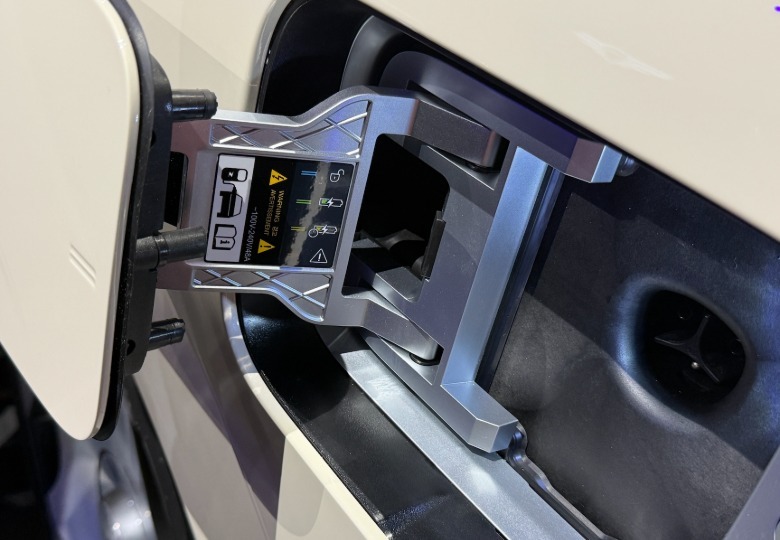
These challenges may explain why there is some truly beefy engineering found in the Neolun’s gaping doorsills. The most notable, of course, are the massive rear Dual-Motion Hinges, which a spokesperson for the company said are both robust and “aesthetically pleasing.” They’re right, too. If you’re someone who appreciates mechanics, this thing is beautiful. It makes sense why the hinges were purposely designed to catch the eye when the rear doors are opened. Contained within that massive hinge are dozens of ball bearings that ensure a smooth operating procedure. It’s all very neat and somewhat mirrored by the hinge that opens and closes the motorized charge door (above), which is also gorgeous.
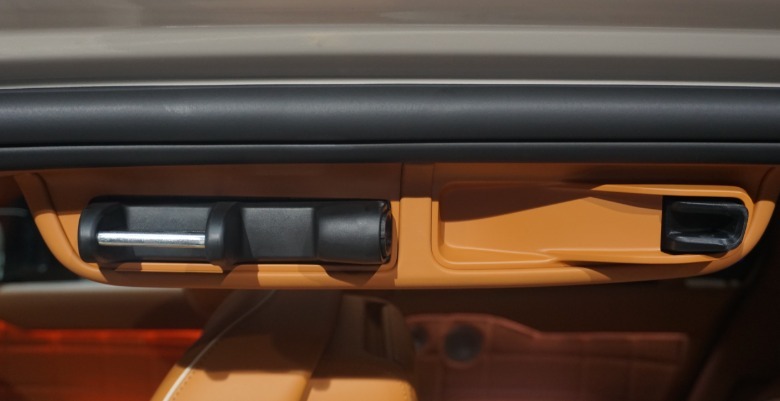
There are other signs that safety and rigidity were paramount here, as well. The rear doors themselves carry a massive hunk of hidden B-pillar, and there are some latch and pin mechanisms in view along the top-center of the Neolun’s door opening. They’re fairly well integrated, but I wouldn’t be too shocked if they prove to be something people clonk their heads into every once in a while.
 Andy Kalmowitz / Jalopnik
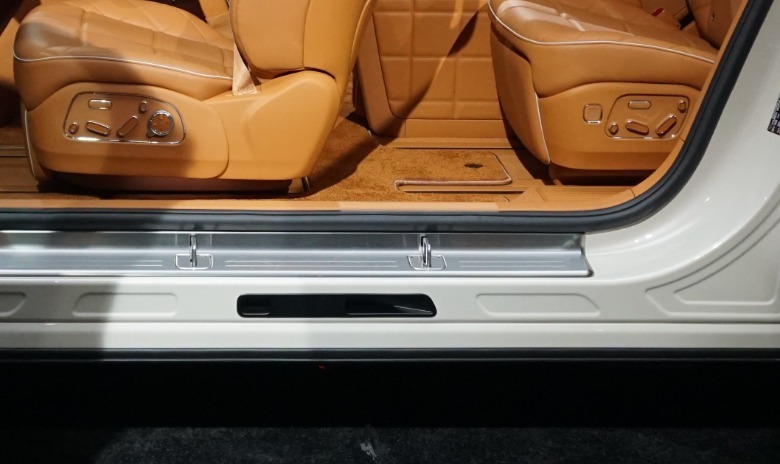
Probably the least aesthetically pleasing element of the door opening are the two latches that sit on the SUV’s sill plate. I cannot imagine the internal fights that happened around those two things or how annoyed the designers were that no one could figure out a better way to integrate them. They unfortunately don’t look that nice, but are a very small price to pay for an otherwise fantastic package. And just check out how long the door sill is.
There are more hidden safety features under the skin to up the GV90 Neolun’s rigidity, including a couple of high-strength dual steel beams integrated into the doors. Genesis says the architecture that joins the doors and body is meant to disperse the force of a collision. Then there’s the hidden roll cage, made from “a frame 1.5 times thicker than conventional vehicles” that uses integrated high-strength steel tubes and structural foam.
 Andy Kalmowitz / Jalopnik
All of this combines to give the GV90 Neolun the highest-in-class body stiffness, according to Genesis, so I suppose the chairman’s wishes were granted, and I think we’re all the better for it. I mean, just look at the thing. There’s nothing else on the road like the GV90 Neolun, and so much of that is down to the Neolun Arch Gate. Now, it’s time to get down to business and give everything in the HMG portfolio one of these systems. I, for one, will not rest until a Hyundai Kona Neolun is sitting in my driveway.
