



- There are no self-driving cars for sale in the U.S.
- Pilot tests of self-driving cars continue to expand, to other vehicles and in other cities
- Most new cars can be equipped with Level 2 driver-assist features on the SAE’s self-driving scale of Level 0 to Level 5
Maybe you’ve seen them: An electric car topped with a hat of roving cameras, sensors, and lidar. Maybe you’ve ridden in them, in select cities such as San Francisco, Phoenix, and Los Angeles: a driverless taxi obeying the rules of the road but unable yet to go on the highway.
Google’s Waymo continues to expand, in both cities and vehicle types. It’s evolving from the Jaguar I-Pace crossover and Chrysler Pacifica minivan into offerings ranging from the Hyundai Ioniq 5 to Zeekr, the EV brand owned by Chinese conglomerate Geely. Waymo is also expanding not just into Austin, Texas, and tiptoeing into other U.S. cities, it’s stepping into Tokyo, Japan.
Like most evolutionary technologies, however, much more is promised than delivered. Tesla claims it will have a two-door robotaxi due “before 2027,” but that seems highly unlikely. In December 2024, GM killed its Cruise robotaxi project after dumping $10 billion in the startup it acquired in 2016.
To be clear, there are no self-driving cars you can buy today. Yet automakers continue to develop hands-free driving systems that offer some degree of autonomy. That was one benefit of GM’s investment in Cruise. To date, GM’s Super Cruise ranks highest among the handful of hands-free driving systems available on limited highways in the U.S.
What is the difference between self-driving cars, hands-free autonomous systems, and all the goofy names automakers slap on their advanced driver-assist systems? We’re glad we asked.
While the levels of semi-autonomous driving sophistication can vary significantly from one brand to another, the defined bounds of those levels are relatively set.
In 2014, the Society of Automotive Engineers (SAE) adopted a common taxonomy for self-driving cars that defined six levels—from Level 0 to Level 5—of automated driving. The boundaries are pretty obvious. Level 0 was no assistance and Level 5 was fully autonomous. The SAE updated their tiers in 2021, and while Level 5 remains fully autonomous, Level 0 has changed to include some active safety features that have become commonplace if not standard in the last few years, such as automatic emergency braking.
Fun fact: Did you know that the first autonomous driving feature debuted in 1958? The 1958 Chrysler Imperial was the first car to have cruise control, originally dubbed “Auto-Pilot.” Tesla co-opted it more than a half-century later, and it’s still a misnomer, as is the EV brand’s Full Self-Driving.
That’s why it’s important for car shoppers, automakers, and their dealers and marketing departments recognize the six distinct levels as put forth by the SAE. The big jump comes from Level 2 to Level 3, and automakers such as BMW, Mercedes-Benz, GM, and even Honda ready their vehicles for Level 3 tech.
Level 0: No self-driving functions at all. Drivers are responsible for controlling steering, throttle, and braking. They’re also responsible for monitoring everything around the car. Level 0 includes features that provide warnings and temporary assistance, including automatic emergency braking, blind-spot monitors, and lane-departure warnings. The vast majority of cars on the road today fall into this category.
SAE levels of driving automation, from none to fully self-driving
Level 1: Some driver assistance is allowed. In cars equipped with Level 1 automation, the car can take control of the steering or the throttle/brake in certain situations, but it relies on the driver to immediately take over if those systems fail. Many newer cars are equipped with adaptive cruise control that can slow the car to a stop, which falls into this category. Some cars are equipped with active lane control (also known as lane-departure prevention) systems that allow for limited periods of hands-off driving.
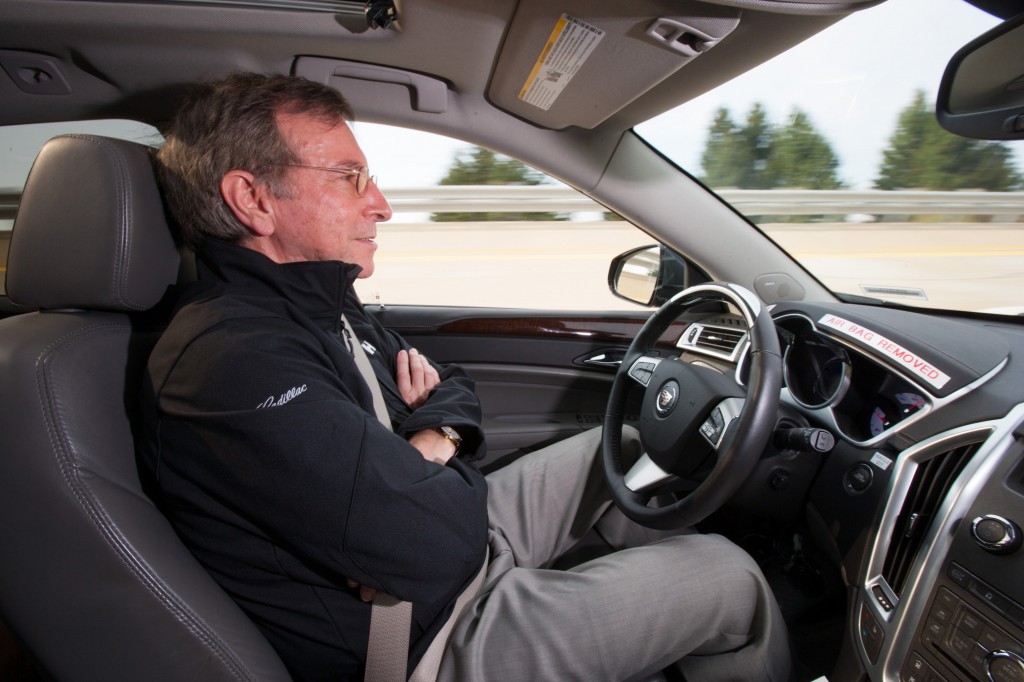
Cadillac’s Super Cruise system undergoing testing.
Level 2: More driver assistance. Level 2 automation differs from Level 1 in how many systems are used to assist drivers, but the two levels are identical in requiring drivers to immediately take over if those systems fail or stop operating. Level 2 allows for the use of adaptive cruise control and active lane control at the same time. Several automakers offer systems that will take control of the throttle/brake and steering for a limited time, but require driver interaction. If the driver doesn’t take over, those systems stop, usually with several warnings to the driver. Some of today’s most sophisticated systems can handle all the controls at full speed on the highway but still require the driver to monitor the road ahead. The best of them is GM’s Super Cruise. Ford’s Bluecruise and Tesla’s Full Self-Driving also qualify here.

Mercedes-Benz Drive Pilot Level 3 self-driving system
Level 3: Level 3 consists of conditional automation. Level 3 automation can handle all driving situations in certain situations and constantly monitors the road, unlike Level 2 cars. Level 3 still requires a driver to take over in certain situations, so the car must come with a steering wheel and gas and brake pedals. Mercedes-Benz’s Drive Pilot system is considered Level 3 up to 59 mph, but it’s allowed only on select highways in California and Nevada. Honda has a Level 3 system operational in Japan, but the brand is still assessing how to overcome state-by-state regulatory issues in the U.S. BMW and Stellantis have both promised Level 3 systems for the U.S.
Level 4: Nearly self-driving. Most automakers are targeting Level 4 automation for several reasons. First, it’s likely to be cheaper because Level 4 self-driving cars may not require driver controls such as a steering wheel, throttle, or brake pedals—building a car with redundant controls for both the driver and autonomous systems would be costly and complicated. Second, Level 4 differs from Level 3 primarily because it doesn’t require human intervention if self-driving systems fail, as in the Waymo cars.
Level 5: Fully self-driving. This may seem like a logical small step from Level 4, but for most automakers, Level 5 autonomy is a giant leap for self-driving cars. Level 5 cars would be self-driving, all the time, everywhere. Considering most of the nation’s roadways aren’t pencil-straight interstates on a sunny day, the final SAE level would require extensive testing for sensors that can’t yet read road lines in bad weather, low light, on dirt roads, or countless other variable circumstances. Although having a steering wheel and pedals wouldn’t preclude a car from being Level 5, to achieve the designation those controls would be useless: Level 5 cars aren’t driven by humans in any circumstance.
—Senior editor Kirk Bell contributed to this report.
